Blog

Uncategorized

World Kid Lit Challenge Day 21

Today’s book comes from a different part of the world to the rest of this week’s books but highlights the challenges facing different communities. Chosen from Planet Picture Book’s fantastic selection, here is Mama’s Nightingale, A Story of Immigration and Separation by Edwidge Danticat, illustrated by Leslie Staub (Dial Books). Written in English with the occasional Haitian word.

Emma: This is my favourite bit: “sometimes the stories are as sad as melted ice-cream. Other times they are as happy as a whole day at the beach.”

This book is written from the perspective of Saya, a young girl in America, whose Haitian Mama is in the Sunshine Correctional, “a prison for women without papers”. We feel Saya and her Papa’s sadness that Mama can’t be with them and the pain of separation following a prison visit. Mama starts to send Saya a cassette tape every week with a bedtime story recorded on to it and Saya listens to the tape, imagines Mama tucking her in and kissing her goodnight.

Papa keeps writing to newspaper reporters, the mayor, the congresswoman but nobody ever writes back. One day Saya asks if she can write and she does just that. She writes her story in her words which is then sent to the papers. One paper picks up on her story and soon they are inundated with people wanting to talk to Saya and Papa about Mama. consequently, Mama’s case gets brought before a judge (a black female judge!) and finally she is allowed home while she waits for her papers.

The illustrations in this book are wonderful. The colours and the imagery are just fabulous. As I mentioned previously, I love colour and this is so bright and captivating. We see the nightingale pictured on most pages, sometimes in a cage, sometimes free. The use of thought and sound bubbles help to imagine what Saya is thinking and feeling – a locked padlock here, an unlocked padlock later on and Mama, floating all around.

You may notice that Dominic hasn’t made a comment on this one. It’s just that we talked about sooo much, it wouldn’t fit nicely in a comment. This concept of “papers” is completely alien to him. So, first we had to look on his wall map where Haiti is in relation to America. We then talked about work permits, relating that to his aunt, who lives in Australia. We then got onto Brexit and how at the moment we can live and work anywhere in Europe. We used his classroom and classmates as the example of the 49% vs. 51% and discussed democracy. We kept on going and I fetched out my old passport with stamps and visas for places like Australia and India, which he found fascinating. And all because we read a book. Amazing!

Back to World Kid Lit Challenge
Uncategorized

World Kid Lit Challenge Day 20

We’re two-thirds of the way through our World Kid Lit Challenge.

Today’s book is one of my favourites. This is a young adult book from Austria, which rightly won the 2017 Österreichische Kinder- und Jugendbuchpreis (Austrian Children’s and Young Adult Book Prize). Today’s book is the as yet untranslated Dazwischen: ich by Julya Rabinowich (Hanser).

My suggested title is “Torn between two lives” and the story begins like this:

Wo ich herkomme? Das ist egal. Es könnte überall sein. Es gibt viele Menschen, die in viele Ländern das erleben, was ich erlebt habe. Ich komme von Überall. Ich komme von Nirgendwo. Hinter den Sieben Bergen. Und noch viel weiter. Dort, wo Ali Babas Räuber nicht hätten leben wollen. Jetzt nicht mehr. Zu gefährlich.

Where do I come from? That isn’t important. It could be anywhere. There are many people in many countries who live through what I have lived through. I come from everywhere. I come from nowhere. Beyond the seven mountains. And much further still. A place where Ali Baba’s thieves wouldn’t want to live. Not anymore. Too dangerous.

What a way to begin a book!

In her debut book for young adults, Rabinowich depicts Madina’s arrival in a new country and the struggles she now encounters. These are not just the physical difficulties regarding language and the conditions where she lives, but also the pull of family and tradition against the desire to discover more about her new surroundings and engage with her new friends. As the narrative unfolds, we are offered glimpses of the journey she has undergone to reach this point and the life she has left behind. Madina is a strong female protagonist who must ultimately work out a way for her family to stay in their new country, pulling together the women in her family and those around her to ensure their safety.

This narrative is a moving account of the difficulties faced by young people as they arrive at their destinations. We never discover where Madina comes from and other than the references to learning German, we never learn where she has arrived. For young people across Europe, who are coming into contact with new arrivals from distant lands, this book opens their eyes to what life may be like for their new schoolmates and neighbours. A particular favourite passage is this one, which tells of how some days, Madina can’t get in the bathroom to have a shower before school and how her friend, Laura, helps her out:

Wir haben jetzt ein Seifenversteck ins Klo gemacht, damit es nie wieder passiert. In der dritten Kabine vom Mädchenklo ist eine Kachel in der Wand locker. Dahinter hat sie eine kleine, in rosa Papier verpackte Seifenkugel versteckt, und ich schleiche in der ersten Stunde auf die Toilette und wasche mich mit dieser kleinen Seife, die so toll nach Rosen duftet, als würde ich in einer Wanne voller Blumen baden. 

We’ve made a hidey-hole for some soap in the toilets so that it never happens again. In the third stall of the girls’ toilet there’s a loose tile on the wall. Behind it, she’s hidden a little bar of soap, wrapped in pink paper, and I sneak out to the toilet during the first lesson and have a wash with this little bar of soap that smells so sweetly of roses, as if I had bathed in a whole tub of flowers.

At a time when we here in the UK seem to be closing our borders and shutting people out, this book can help our young people to understand and welcome those who so badly need our support.

For anyone in the East Midlands area who would like to help refugees and asylum seekers or if you would like to make a donation, please visit http://www.derbyshirerefugeesolidarity.org


Uncategorized

World Kid Lit Challenge Day 19

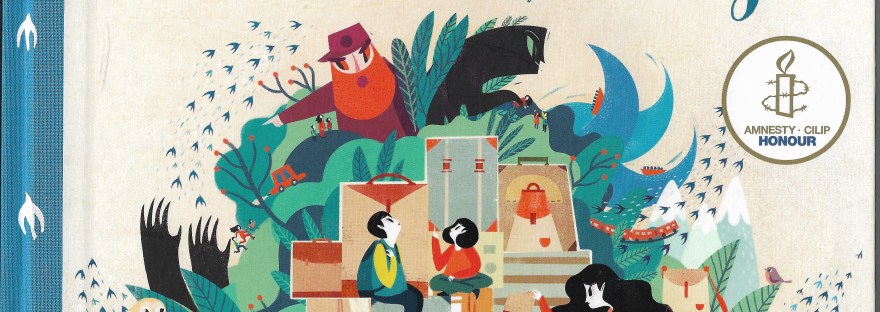
Continuing the theme of fleeing from war, today’s book is one that has been endorsed by Amnesty International: The Journey by Francesca Sanna (Flying Eye Books). While Sanna grew up in Italy, I believe this book was originally produced in English.

Emma: I like all the birds at the end. I wouldn’t like to do a journey like that. 

As the author explains, this isn’t a book about a specific journey and, as such, the reader isn’t told where the family are fleeing from and where they are going to. The book is written in the first person from the child’s perspective. One particularly heart-wrenching page is nearly all black with the words: And one day the war took my father. The mother is left alone with her children and takes the decision to leave the country with her two children.

As a mother, this much be such a difficult decision to make, to be responsible for two other little beings on such a journey. The inner strength of the mother really comes through. On one page we see the mother holding her awake children to her and the colours around her include splashes of oranges and yellows and greens. On the opposite page we see the same image but the children are asleep and only now does the mother release her tears, the colours now muted blues and darker greens. I love how the tears form part of the the mother’s hair.

As the family progress on their journey, we see all the different ways they travel: in their own car, in the back of a van, in a lorry squashed among vegetables, on a bike, on foot, by boat and finally by train. We feel the despair and the fear along the way, as they hide in bushes trying not to attract attention to themselves. We leave the family on a train, crossing many borders. As they look out the window, they see birds flying, migrating “just like us”. The books closes saying: I hope, one day, like these birds, we will find a new hope. A home where we can be safe and begin our story again. Powerful words from a powerful book.

The illustrations in this book are just stunning and there is such detail, cleverly weaving dangerous looking eyes and fingers into the background. Emma was very drawn to the little fox  in the woods. The colours are glorious and this is another book where the printing and paper quality feel give this book a fantastic feel.

Uncategorized

World Kid Lit Challenge Day 18

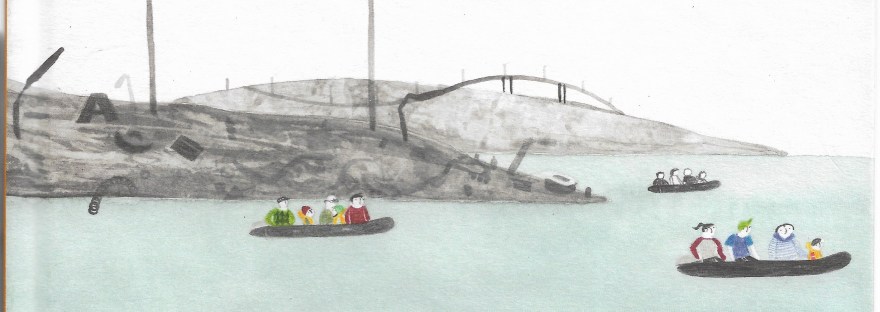
Today’s book comes from Austria and is another book that is yet to be translated: Flucht (Flight) by Niki Glattauer and Verena Hochleitner (Tyrolia Verlag).

Dominic (7): They are leaving their home because their country is in war. It must be bad where they are living. They are not taking much stuff with them. I think travelling on the sea must be a bit scary.

The books opens with:

Katzen haben sieben Leben, heiβt es, darum haben sie mich mitgenommen. Vater hat gesagt: Das wären dann elf. Die können wir auf dem Meer gut brauchen. Er hat es lustig gemeint, aber niemand hat gelacht.

Cats have nine lives, that‘s why they’ve brought me along. Father said: “That makes thirteen. They’ll be handy when we’re on the sea.” He meant it to be funny but nobody laughed.

This book is a little unusual in as far as the story is told from the cat’s perspective. His name is E.T. like the alien in the film who calls for help. E.T. leads us through the family’s preparations to leave their war-torn home and make the journey across the sea. We are told Daniel’s packing list:

1 pencil case with pencils, crayons and felt-tip pens, 1 notebook, 1 bag of Lego Minecraft, 3 shiny stones, 1 mobile phone, 1 laptop, 1 pair of jeans, 2 pairs of shorts, the Messi T-shirt, 5 other T-shirts, 1 black leather jacket, shoes with the green flashing lights, 1 other pair of shoes, underwear and socks, 4 large bottles of water, 1 small packet of documents and 1 large packet of old photos. 

Seeing these items laid out with the rucksack underneath really brought it home for me how very little this family are taking with them but also what they are taking. For Daniel, the Lego and his Messi T-shirt, but photos, a phone and a laptop. Sometimes I think we have an image of refugees as people who in their original country had nothing. We perhaps picture them as poor, living in a rundown hut. Of course, some people do live like that, but many come from societies which are, or were, just like ours. I recently read Yusra Mardini’s Butterfly, from Refugee to Olympian, which really helped me to understand that these people fleeing had nice houses, they had laptops and the internet and all the stuff that we have. And this book goes on to confirm that:

How will we cook noodles if we have no electricity?” Mother asked. “And how will I surf the internet?” asked Suzie.

The illustrations are very effective – one page shows a single small boat on an expanse of blue. Towards the end of the journey, Daniel starts to talk of the water-ghosts, which are a little scary and as such, I decided not to introduce this to Emma. I read one review on Amazon suggesting that this was a book to read with children rather than leave them with and I tend to agree. There is so much discussion that can be had from this book, but younger children might find it too much.

And Glattauer and Hochleitner save the twist in the book right to the end: these people are not fleeing to Europe, but fleeing from Europe to Africa…


To help support refugees and send aid to where it needs to be, please look up Derby Refugee Solidarity: http://www.derbysrefugeesolidarity.org


Uncategorized

World Kid Lit Challenge Day 17

Given our current troubled times, perhaps it is unsurprising to find children’s books and YA literature springing up that deal with war, fleeing, immigration and integration. The next five books are all going to deal with these current issues.

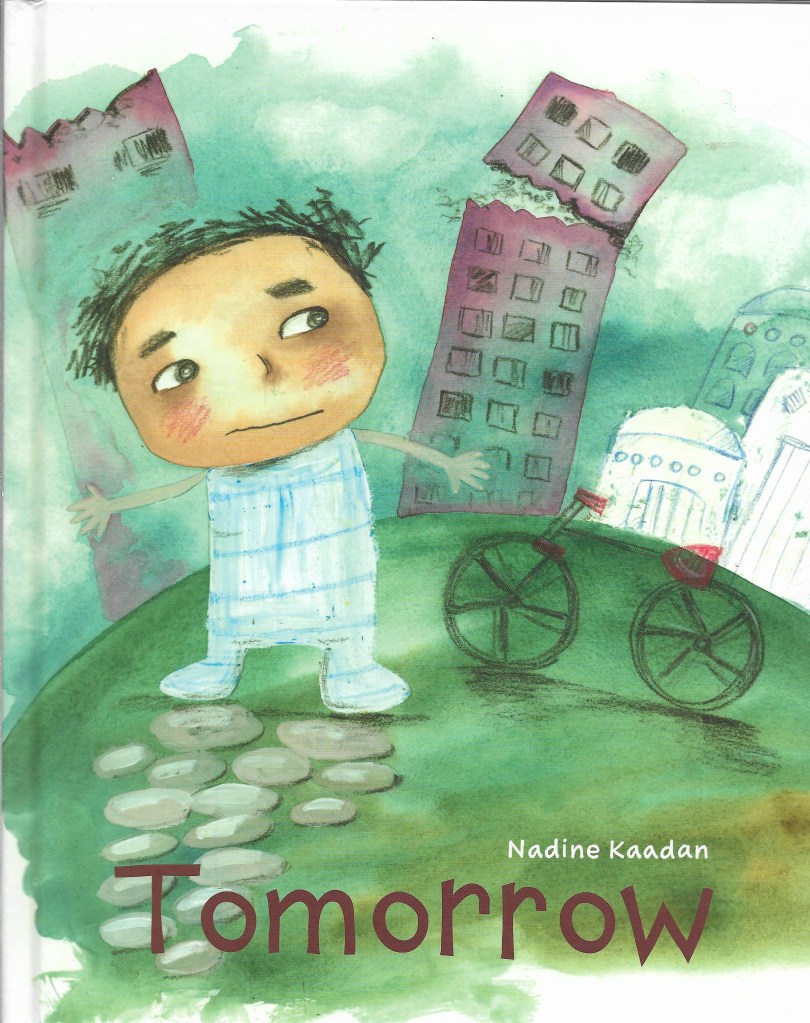
The first book in this little series is Tomorrow by Nadine Kaadan, translated from Arabic by the author (Lantana Publishing).

Dominic: It’s about a boy called Yazan. Everything around him is changing and he can’t go to the park because there are people fighting on the streets. It’s too dangerous. It’s important for children like me to read this book. It tells you what life is like in Syria. 

Emma: The shadows on the floor look like bad news. Someone’s broked (sic) the houses. It’s sad that Yazan can’t go outside. 

This book tells the story of Yazan who can no longer go to the park. He no longer goes to school. He even starts to miss it “which was a surprise”. It’s too dangerous to be outside and Yazan’s mother has become so preoccupied she doesn’t even paint anymore. But Yazan’s concerns aren’t about the news; he wants to go to the park. One day, Yazan decides he’s going to the park, takes his red bike and leaves the house alone. Everything is different to how it used to be. I won’t spoil the ending, but needless to say, he makes it home again safely.

The illustrations in watercolour and pencil are beautiful and the colours really help to convey Yazan’s feelings – dark and gloomy when he’s worried or angry compared to the red of his bike or bright colours in his park at the end. At the back of the book, Nadine explains the effect of the situation on her own colour choices, which is reflected in the illustrations. She also explains to the reader why she is writing this book.

One of my concerns had been about broaching this subject with 4-year-old Emma and whether she would find this all a bit scary (Dominic aged 5 had experienced nightmares about bombs falling on our house off the back of an aid collection for Syria). While the pictures are at times dark and eerie and, as Emma comments, the buildings pictured are damaged, they aren’t portrayed in a particularly scary way.

In her letter to the reader, Kaadan begins asking, “Have you ever been stuck inside the house when you’re desperate to go outside?” Most children probably can. I think it’s really clever that she has taken such a serious issue and created story around a situation that a child who has never experienced war can understand. Emma doesn’t really get why Yazan can’t go outside yet her comment above shows that she can empathise with his feelings of being stuck indoors. Ultimately, I thought this was a great book to introduce the situation to a younger child.

Having helped with various collections for the amazing grassroots movement Derby Refugee Solidarity, Dominic is already aware of war and refugees but on quite a superficial level. This was a good book for him to consider the children like him growing up amid war and he seemed quite impressed that this book was actually set in Syria.

For anyone local to the East Midlands, who would like to help provide aid and support for refugees both here and abroad, please get in touch with Derby Refugee Solidarity to find out more about their current campaigns (www.derbyrefugeesolidarity.org).

Back to World Kid Lit Challenge