Blog

Uncategorized

World Kid Lit Challenge Day 26

Today’s book is a chapter book “for ages seven to 107”: Toletis by Rafa Ruiz, translated from Spanish by Ben Dawlatly (Neem Tree Press).

Dominic: My favourite bit is the Wobbegong language because it was really funny. How do you say “treenie-weenie” in Spanish anyway?

Toletis is a story of nature and noticing. The book takes us on a journey through the year, with three chapters dedicated to each season. Early in the book Toletis sees the trees in his town disappearing and sets out with his friends to turn their valley green again. Along the way, we meet the treenie-weenies who are “the souls of all the trees that had been felled in the town over recent years”. We also get introduced Aunty Josefina and her Wobbegong language.

In summer, a boy, Alexander Atherton-Aitken (A-A-A) comes to the town who had been “brought up in the city”. We join him as he discovers the countryside, as he worries about getting his shoes muddy  and whinges about the ants. Toletis and his friends play a game called the Sounds-of-Silence. You have to lie in silence and listen to what they can hear – “the clinking of cowbells”, “the incessant song of the crickets” and the “rustle of the poplar trees in even the lightest of breezes.”. A-A-A we are told “always won the games on his smartphone. However, he always came last in the Sounds-of-Silence game.” What an important message to us all in our busy lives to stop, put our phones down and take heed of what is around us.

This book must have been so much fun to translate and it was one of the books on the challenge that really made me want to seek out the original text and wonder how I would have done it. Dominic and I also had discussions about what the words in Spanish might have been and how you get to these English ones. I love the descriptive language used throughout and it’s a really gentle book. As we talk about male role models for our children, particularly our boys, it’s great to have a story of a strong but sensitive boy who is interested in helping save the planet and noticing the smaller details. Our boys are not all rough and tumble and superheros. I love this book for honouring our thoughtful boys.


Uncategorized

World Kid Lit Challenge Day 25

With just a few days left of September, we’re sprinting down the final straight with some fantastic books. First up we have the great little picture book Valdemar’s Peas by Maria Jönsson, translated from Swedish by Julia Marshall (Gecko Press).

Dominic: It is funny. I like when he sets up a trap and his sister eats the peas.

Emma: I like the ending. And I like chocolate ice-cream too!

It’s dinner time and Valdemar has to eat his peas: ‘Papa decides “The peas go in the tummy. Then ice cream. Chocolate ice cream”.’ What Papa didn’t say, however, was whose tummy. The illustrations are great in black, red and pea green showing the dynamics between Papa, Valdemar and little sister Lynn. The simplicity of the story is great and the kids could really identify with it, giggling about Valdemar’s plan to get the ice cream. I also love the fact that it’s Papa who is in charge of dinner time – Dads can cook too!


Uncategorized

World Kid Lit Challenge Day 24

So today’s book review isn’t actually written by me. Just to show what a family affair this challenge has been, today’s review is written by my lovely husband, Jonathan. As a book for slightly older children, today’s tester is 10-year-old George who did me an amazing book review! I think I might be out of a job with these two today!

Today’s book is The Big Bad Fox by Benjamin Renner, translated from French by Joe Johnson (Roaring Book Press).

George: It’s all about a fox who stole chicks but loved them. I loved the bit where the fox was a live dummy for the chickens. It made me wonder whether this would happen to real animals. Overall, this book was awesome and the pictures were fantastic! 

“Who’s afraid of… The Big Bad Fox? No one, it seems.” Such is the inability of the fox in Renner’s comic book story to strike fear into the hearts of other creatures that even a captured bird prefers to be eaten by the ruthless wolf than by the hapless fox (“If I have to get eaten, it might as well be by a creature with flair.”).

After a series of increasingly pathetic attempts to capture and eat any chickens, the fox and the wolf ‘hatch’ a plan to steal some eggs from the farm. The plan almost fails, but the fox’s perceived harmlessness for once works in his favour and he manages to return to his lair with three eggs. All is going according to plan until the chicks hatch and latch onto the fox as their mother.

The book then focuses on the comic attempts by the fox to rear the chicks for a future meal, even to the extent of making them sleep in a cooking pot. The chicks, however, have other ideas. This section deals entertainingly with a lot of issues that will be familiar to any parent: the chicks refusing to sleep, making too much noise, not making enough noise, bombarding the fox with inane comments, and so on.

Meanwhile, the chicks’ mother, frustrated by the guard dog’s unwillingness to properly investigate her chicks’ disappearance, forms the “Fox Exterminators’ Club” to train up the hens to deal with a future fox attack. This provides for a perhaps surprising level of cartoon violence reminiscent of old Tom and Jerry cartoons. Examples include a dummy fox being decapitated with an axe ‘off-screen’ and then rolling into the cartoon frame, or the hens attending a lecture on “100 ways to eviscerate a fox” (“So, you take a fox and a drill, and then you…”).

Things come to a head when the wolf suggests that the chicks are now big enough to eat. Can the fox go through with the original plan, or has he grown too attached to them? How can he and the chicks escape the wolf’s clutches? And will the hens ever get the chance to put their rigorous military training into practice?

The illustrations are wonderful and the dialogue is witty; together this imbues each animal with a lot of individual character: the ill-fated fox, the belligerent hen, the apathetic guard dog, the sardonic wolf. It is a hefty book but it draws you in and keeps you interested. It certainly has at least one of the characteristics of a great children’s book: it is a great read for adults!


Uncategorized

World Kid Lit Challenge Day 23

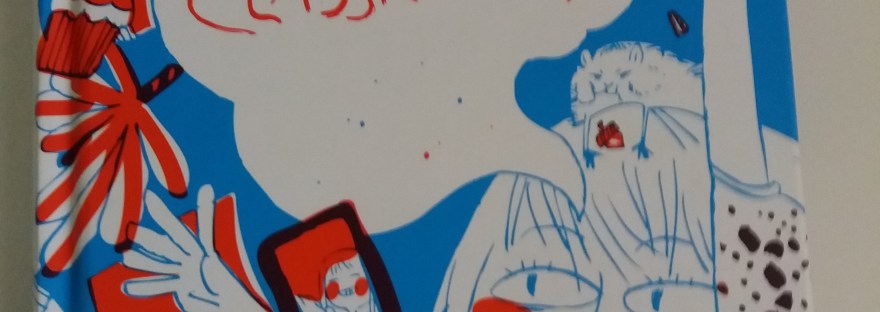
Today’s book is our one and only poetry book on the challenge. Introducing The Noisy Classroom by Ieva Flamingo, illustrated by Vivianna Maria Stanislavska. Translated from Latvian by Zanete Vevere Psqualini, Sara Smith and Richard O’Brien (The Emma Press).

Dominic: My favourite poem is ‘The Schoolbag’s (Secret) Contents’. I’d like to take my cat with me to school. 

Ellie (7 – a school friend): I like the one about the headteacher and how he got told off when he was little. It made me laugh and also think about how he is only human too.

This book is a collection of poems all about school. The illustrations are really vivid in red and blue, showing how effective pictures can be in just a few colours. On the inside covers, we are introduced to some members of the class. I love that these include Anna in a wheelchair – depicted as just another member of class. She does then have her own poem, listing the many things that she can do, stating: “She’s almost, almost exactly like me”. I think this is an important message.

Perhaps my testers were at the lower end of the recommended age group as some of the poems went over their heads a bit – I’m sitting in a Wifi Hotspot, for example – however, it’s nice thinking that as they do get older, there is still content in the book for them to grow into. My favourite poem is “School wants”, all about the boxes that kids have to tick in school but that “School doesn’t ask how I am today”.

We particularly enjoyed the section at the back where you can learn some Latvian and the tips from Richard O’Brien about writing your own poem are interesting. Dominic sometimes says he doesn’t know what to write about, as if he needs to have an amazing adventure in mind. It’s really useful for him to be told “have a think about an electronic device you or your family uses … Then see if you can turn these ideas into a poem of your own.” Great to think that you can use your everyday life as a springboard for a story or poem.


Uncategorized

World Kid Lit Challenge Day 22

Today’s book moves us to yet another part of the world: Africa. Precious and the Mystery at Meerkat Hill by Alexander McCall Smith (Polygon).

Dominic: Interesting. It is set in a different country. Normal books are set in Europe but this one’s set in Africa. The pictures in red, grey and black made a nice effect.

Emma: It was funny when the meerkat ended up on the teacher’s head. I like the bit where the meerkat has a ride on the cow. 

Grace (Dominic and Emma’s cousin – 10): It was very descriptive and I actually felt like I was in Africa! My favourite bit was at the end where it was talking about how meerkats sleep at night time.

Precious Ramotswe is the protagonist of the best-selling novel “The No. 1 Ladies’ Detective Agency”. This chapter book for children, written in English, tells of Precious growing up in Botswana and starting to use her detective skills. In this story, two new children start at her school and Precious makes an effort to get to know them realising along the way that the children have no shoes and their small house sleeps six.  When the family’s cow goes missing, Precious steps in to help find her.

We found this gem in the local library. I really enjoyed sharing this one with the kids and opening their eyes to how other people live. Despite being a longer book, Emma was just as engaged with this as Dominic. It led to discussions about life in Africa and how some people don’t have shoes and how important having a cow can be to a family’s livelihood.

Being based on a familiar school situation, the kids could identify with the children despite the new surroundings. The award-winning illustrations are amazing and really add to the narrative. The drawings of the African girls with short hair led to a discussion with Emma about how it is fine for girls to have short hair, just as boys can have long hair.

I have to admit that Dominic’s comment on this one really hit home: “Normal books are set in Europe”. It shouldn’t be that books set in other countries are not seen as “normal”. They should be a regular part of our children’s reading experience, telling them about the world we live in, and clearly I need to make more of an effort in the future to ensure that such books are available to my children.

For anyone interested in introducing Precious to younger readers, the good news is that there are further books in this series of young Precious books.