Blog

Uncategorized

A trip to Austria

Last week we had a family trip to St. Johann in Austria. St. Johann is located in the Tyrolean mountains and the scenery is absolutely stunning. Despite the rain, we managed a couple of trips up the mountains by cable car where we were surprised to find quite a lot of snow. After having received a huge amount of snowfall this winter, the snow is still lying quite thick in places and as a result some of the walking routes are yet to open. However, the kids really enjoyed playing around in it and throwing snowballs at each other!

It was also great to speak German again and be surrounded by the German language. Hearing the Austrian accent again took me back to my time in Innsbruck. While my kids know I speak German and Spanish, they rarely have much chance to hear me in full swing so I think they were a bit taken aback.

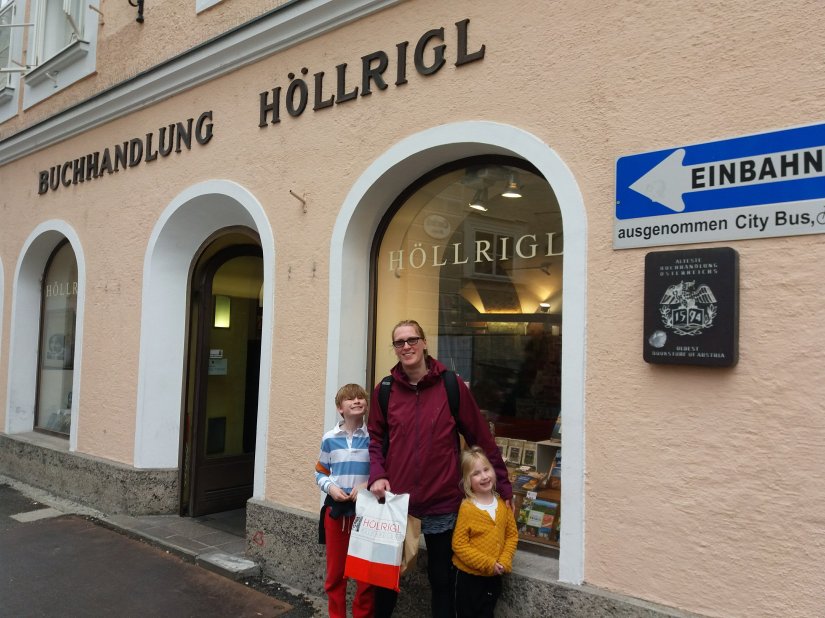
One of the highlights of our trip was a day trip to the beautiful city of Salzburg. Having fruitlessly visited bookshops in St. Johann and Kitzbühel, hoping for a conversation with someone who could talk to me about the new success-stories coming out of Austria, we stumbled across Buchhandlung Höllrigl, “Austria’s oldest bookshop”. I couldn’t resist a visit. The staff were amazing. The two members of staff I spoke to were highly knowledgeable about the books they were selling. As I was asking about children’s books, a specialist colleague in this section was called to come and talk to me, and she REALLY knew her stuff. If anyone’s ever in the area, I would highly recommend a visit… just make sure you take your credit card!
Uncategorized

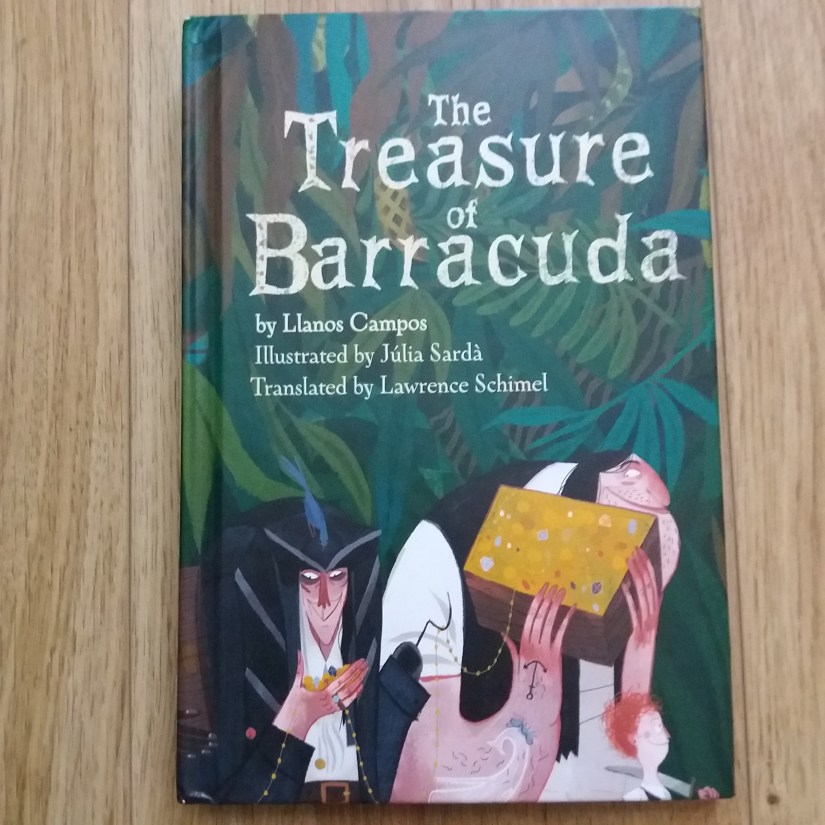
World Kid Lit Review: The treasure of Barracuda by Llanos Campos, trans. Lawrence Schimel

Today’s book review is one that my son and I have really enjoyed together: The treasure of Barracuda by Llanos Campos, translated from the Spanish by Lawrence Schimel.

Dominic (8): It’s really exciting. There are lots of silly words that keep making me laugh – you big mackerel! I also like the glossary at the back. I’d recommend this book to my friends.

So originally, I purchased this book as reference material for my MA, to see how renowned Spanish translator Lawrence Schimel had dealt with various translation issues. Not only did I get a masterclass in doing just that, but my son and I heartily enjoyed reading this fabulous story together.

The plot follows a group of pirates led by Captain Barracuda who have been searching for Phineas Krane’s long-lost treasure. In the first few pages, we join narrator Sparks, Two Molars, One-Eyed Boasnovas and the rest of their gang on the brink of uncovering the treasure. But as they open the chest, the pirates discover … a book. But what use is a book to a group of illiterate pirates? From here, we accompany the pirates on their journey of discovery, as they learn to decipher the letters and words included in the book. We see their joy and astonishment at the realisation that they can now understand the world around them from a whole new perspective. It’s a clever plot highlighting the importance of reading in a really fun and exciting way.

One of the things for me to gauge the success of a book is on its target readership. I must admit, Dominic was a bit reluctant to give this a try, so I decided I would read it to him, something we don’t do as much as we used to. Cue several reading sessions together. I think it is testament to the plot and to the translation that he very quickly engaged with the story and at the end of each chapter, I was badgered with “keep going, keep going, read the next one!” There were frequent bursts of laugh out loud laughter from both him and me. He also made sure he had a good view of any illustrations along the way, spending time working out which pirate was which and they really added to our experience.

At the end of the book, Sparks alludes to the group’s next adventure. Dominic was very interested in knowing the name of the next book in the series. Unfortunately, it hasn’t yet been translated into English so for non-Spanish speakers, that’s frustratingly as far as it can currently go. Dominic has tasked me with coming up with a translation – “chapter one by bedtime tonight, ok Mummy?” (tough client!). But what better praise do you need than an 8-year-old-boy wanting to read more!

Back to Book Reviews

Uncategorized

ITI Conference 2019 – Reflections

Last week I attended my first ever ITI Conference. What an incredible experience! I have talked to lots of people, danced my heart out to the Accoustic Angels and learnt so very much from some truly inspiring people. Here are some of my highlights from the Conference as well as some recurring themes that cropped up for me.

Inspiring speakers

With so many to choose from, many of the talks I decided to attend followed the literary translation strand of which there was plenty to enjoy. Lucianda Byatt’s talk on the translation of nonfiction texts reminded me to not to overlook this important area of literary translation and offered tips about working practice and liaising with publishers. Carolina Smith de la Fuente chose translating the illustrated book as her topic, a fascinating look at the challenges involved once you add illustrations into the mix. I found David Warriner’s talk hugely encouraging as he spoke on his five-year journey as an emerging literary translator – it is possible to live the dream! Daniel Hahn entertained the room with his whirlwind run through a week’s translation workshop condensed into half an hour. One comment I take away from that session being that we learn so much, if not more, from looking at and discussing other people’s work, not just having our own work looked at. Also noteworthy were Oliver Kamm’s keynote speech and an oh-so-important discussion from Alison Hughes on outreach into schools, universities and businesses.

Parenting as a recurring theme

As a mum myself, I found it interesting to hear how many times it was proven that becoming a parent has such a massive impact on people’s lives and careers. The Hoxby Collective’s Lizzie Penny stated this as her turning point to carve out a new path with her career. David Warriner was inspired to move into literary translation to line his daughter’s bookcase with the legacy of “books translated by Dad”. And there were numerous conversations with others like me who have turned to translation as a flexible career after children.

The importance of supporting each other and building your network

Through membership of the East Midlands Regional Group, walking into my first Conference felt far less scary than I had imagined. I knew that among these new faces, I would also find several people who I now class not only as translation colleagues but also as friends. The Gala Dinner was not simply a “work do”, but a hugely enjoyable social gathering as well. Knowing people in advance of the event was also a huge benefit when meeting new people – to be introduced to a new contact by an existing contact was great and much less terrifying than having to constantly approach new people.

I was really surprised at the apparent success of my tweeting over the last year. I lost count of the number of people who upon hearing my name replied with: “I think I’ve seen you on Twitter”. From the day not so long ago when I reluctantly signed up after my mentor Ellen Worrell suggested it, I am now a huge advocate of its use. It has helped me to build my network and allowed me to be in contact with people I would never otherwise have heard about.

Awards

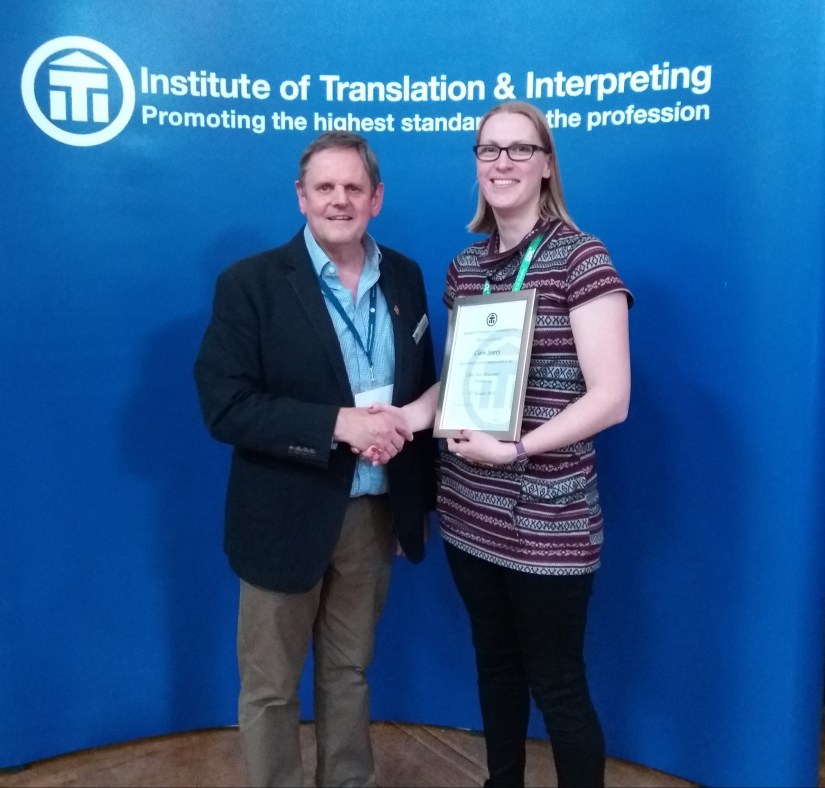
Receiving my certificate from ITI Chief Executive Paul Wilson

I was very pleased to receive a special commendation from ITI in the Best Newcomer (Freelancing) category. Having been informed of my commendation some weeks ago, I was intrigued to discover who had pipped me to the post and won the prize. The winner was announced Corrine Harries, a fellow student (former student in her case) on the Bristol MA course. I know how hard I have worked over the last year to get to this point and I take my hat off to Corrine for having won this award. I am, however, very proud of my own achievement and my certificate will take pride of place in my office.

Thank you so much to the team at ITI for creating such a varied and interesting programme. I can’t wait for the next one!

Uncategorized

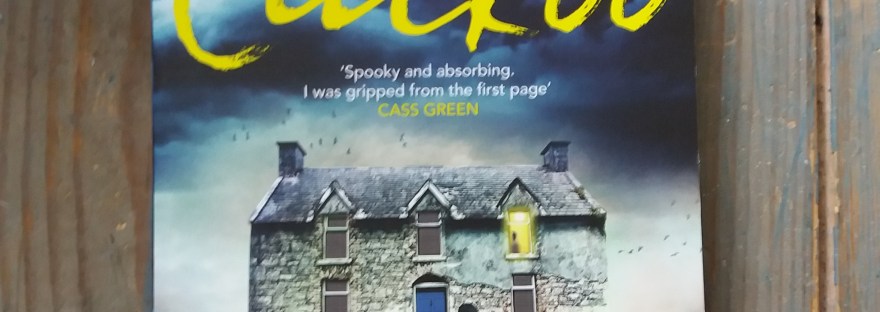
Book Review: Cuckoo by Sophie Draper

Back in February, I was given Cuckoo by Sophie Draper as a birthday present. I often read around the globe, so it was a pleasant change to read something set so close to home here in Derbyshire. I loved the references to Derby, Ashbourne, Carsington Water, and at one point the protagonist surely drove up the A52, pretty much waving at my house on the way!

Having known nothing about the book as I was given it, I discovered it was a psychological thriller. The protagonist Caro returns home to a small Derbyshire village following the death of her step-mother. She is escaping an abusive relationship in London and the timing to move in and clear out the house seems perfect. But weird things start to happen in the house and Caro begins to doubt her own mind. Over the course of the book, a family secret is revealed of which Caro has no memory and the scent of revenge is in the air.

One of the other things I really enjoyed about this book was its descriptive language. Caro is an illustrator working on a commission for illustrations to accompany some fairy tales. But not the happy, floaty fairy tales that perhaps spring to mind; these ones are dark and dangerous. Through Draper’s descriptions, I could really conjure up the pictures in my mind and not only that, the image of Caro working at the table to create them. I also loved how Caro explained to Craig about her passion for drawing and how she experiences life through colour, with words becoming images that dance, leap and spin.

There were plenty of twists and turns to keep me guessing. The only word of caution I would have is that the ending is left somewhat ambiguous. If you like a thriller with all the ends tied up neatly, this probably isn’t the one for you. I still have days where I wonder what happened to Caro in the end. Did she get her happy ending? I’ve seen that Sophie Draper is due to appear at the Derby Book Festival in June. Perhaps I’ll go and ask her!

Uncategorized

Kid Lit Book Review: Ish by Peter H. Reynolds

After a busy few weeks finishing off my MA dissertation, I’ve finally submitted it (hurray!) and I have head space again to think about other things. Despite having neglected my book reviews, I have read some great books over the last few months, so over the coming weeks, I shall endeavour to catch up.

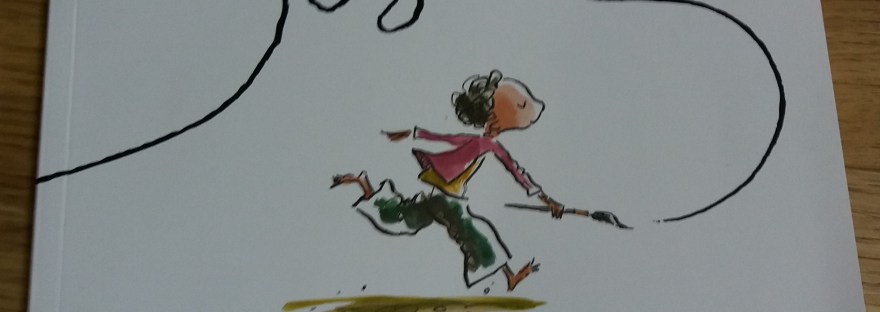
To kick things off, I’m starting with a picture book: Ish by Peter H. Reynolds.

Dominic (8): It’s good… ish! (haha!) It’s good that Ramon knows that nobody is perfect. 

In this book, Ramon loves to draw, but one day his big brother Leon looks over his shoulder, laughs out loud and asks, “What is THAT?!” I’m sure we’ve all been there, that moment, when someone else laughs at what you’re doing or tells you you’re rubbish, perhaps shattering your dreams – I know I have! Ramon keeps on drawing, but his brother’s laughter haunts him until one day, he puts down his pencil and says, “I’m done.”

As he does so, his little sister Marisol is watching him and when he grumpily snaps at her to go away, she grabs the nearest crumpled-up piece of paper off the floor and runs to her bedroom. Ramon follows her in hot pursuit but as he chases her into her room, he pulls up short: her bedroom walls are covered with his crumpled artwork. While he sees failed pictures that don’t look right, she sees art. Ramon comments, “that was SUPPOSED to be a vase of flowers” and Marisol replies, “Well, it looks vase-ISH”. As they look around the room together, Ramon starts to see his artwork in a whole new light. It gives him the inspiration to continue with ish drawings that he realises can incorporate ish feelings, that can be expressed through ish words and ish poems.

This is a book that we have shared a lot at home. When there is so much pressure on kids to get things right, I love that it reinforces the idea that our creations do not need to be perfect. The charm and importance of them often comes from them being “ish”.

It’s also been a great conversation starter about the effect our words can have on other people. We’ve talked about how Ramon feels after Leon laughs at him and how much influence and power Leon perhaps unwittingly holds. Leon may not even remember that day, but in Ramon’s mind, that was a critical moment.

And with the current spotlight on diversity in kids’ books, I also love that the protagonists have Hispanic names and darker skin tones in the illustrations. All in all, this is a great addition to our book shelf!