Reviews

INK KNOWS NO BORDERS: POEMS OF THE IMMIGRANT AND REFUGEE EXPERIENCE

Over the last few months, I’ve been reading some amazing middle grade and young adult books. Over the next few weeks, I’ll be sharing some of my favourites. Some are in translation and some are written originally in English. I’ve also expanded my reading to include poetry, which isn’t an area I’m usually drawn to, and I’ve not been disappointed. So that’s where I’m going to begin.

INK KNOWS NO BORDERS: POEMS OF THE IMMIGRANT AND REFUGEE EXPERIENCE
Edited by Patrice Vecchione and Alyssa Raymond (Seven Stories Press)

Referred to by Kirkus Reviews as a “symphony of poetry” this collection of 65 poems has been written in English by poets from across the world, all of whom are first or second-generation immigrants and refugees. There is a real mix of heritages, including Hispanic, Asian, African, Middle Eastern, but also poets from the US territories of Puerto Rico and Guam who talk of feeling “foreign in a domestic sense” (Craig Santos Perez – Off-Island Chamorros).

The collection has a clear progression, opening with a poem by Joseph O. Legaspi entitled Departure: July 30, 1984. From there, the poems discuss childhood, schooling, family dynamics, pride and longing. A particular theme of identity emerges, grappling with acceptance and love for one’s own being. There is also defiance that grows out of shame, a call to be proud and unapologetic for who you are. Franny Choi’s Choi Jeong Min opens with:

“in the first grade I asked my mother permission
to go by frances at school, at seven years old,”

As mum to a seven-year-old, I find this especially moving, highlighting the effect discrimination has on children. Even at such a young age, Choi Jeong Min feels she needs to change her name and escape her identity because of the way she is treated by others.

The poems often speak of this reaction from other people, an assumption of who you are based on a name, an appearance or an accent. The line of white people in Bao Phi’s Frank’s Nursery and Crafts, tutting at Mom as she insists she’s been over-charged, irritation changing to sympathy as it turns out she’s right. Marianne Chan’s When the Man at the Party Said He Wanted to Own a Filipino makes you gasp with horror. Ethnic Studies by Terisa Siagatonu is another stand-out poem, a criticism of people who sit and talk about race but that forget “we’re sitting right behind you”.  

Many of these poems shine a light on behaviours that should not have to be tolerated and yet with these poems having been published in their original forms over a span of more than 20 years, we see that little appears to changing. I really liked Brian Bilston’s Refugees, the physical act of reading the poem top to bottom and then bottom to top, encouraging us to upturn our own thinking and see refugees and immigrants differently. In his afterword, Emtithal Mahmoud says: [to make a difference] “You just have to reach out and recognize people. Recognize our fellow humans around the world who are fighting for the right to live.”

Many thanks to Seven Stories Press for the review copy.

Uncategorized

#WorldKidLitMonth starts today

It’s 1 September which can only mean one thing: it’s #WorldKidLitMonth!

Over on the World Kid Lit Blog, we have daily posts discussing all things World Kid Lit: interviews with publishers, editors and translators, book reviews, reports about initiatives and programmes and much more. We are also kicking of some new panel sessions called World Kid Lit LIVE, two online discussions featuring the people involved in bringing about translated books for children. Head over to the blog or take a look at our social media channels on Twitter, Facebook and Instagram.

I’ll also be tweeting (@ClaireStorey16) some book recommendations from my review archive, looking at some of the books that have stood the test of time since our 2018 World Kid Lit Challenge – 30 Books in 30 Days.

In Translation, Picture Books

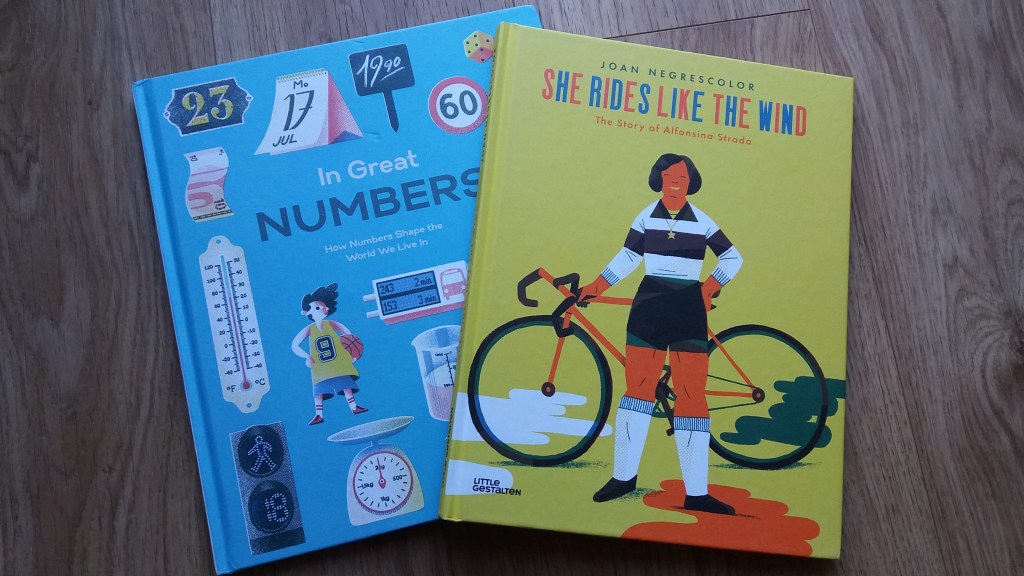
Picture book review: She rides like the wind and In Great Numbers

It’s been a little quiet on here due to homeschooling through the pandemic and getting ready for #WorldKidLitMonth over on the World Kid Lit Blog, but today I’m reviewing two new picture books from publisher Little Gestalten. One of the things I love about Little Gestalten books is how they feel. Recognisable because of their large-scale dimensions, matt finishes and gloriously thick pages, they really are a joy to behold.

In Great Numbers written by Isabel Thomas, Robert Klanten, Maria-Elisabeth Niebius and Raphael Honigstein. Illustrated by Daniela Olejníková.

In our house, numbers are celebrated. My husband and kids love maths so this book has gone down a treat, and not just with the kids. I started flicking through In Great Numbers one evening and it didn’t take long until I was calling over to my husband: “did you know…?” or “listen to this!” Packed full of interesting facts about the history of our counting system and calendar, how GMT ended up being used as the standard measure for time and why computers only use two numbers, I learnt more than just a thing or two. When it was my son’s turn, he too called over, “Mum, did you know…” We really enjoyed having a go at Kaprekar’s Constant. We also had an interesting conversation about a call I had planned with several people in different countries and the times we could or couldn’t meet depending on the different time zones.

The book nicely highlights the global origins of many of the concepts we still use today, from India and Egypt to the Greeks and Romans, with the illustrations conveying this diversity of people. One of my favourite pages is the explanation about money. A long line of people snakes across the page, depicting people from all different races negotiating the exchange of goods. The line starts back in the stone age with two men exchanging animal skins for food, and works its way up through history to the present day where two people are using cards to pay.

She Rides Like the Wind written by Joan Negrescolor, translated from Portuguese by Jethro Soutar.

New out for August, this bright yellow non-fiction picture book from award-winning illustrator Joan Negrescolor, translated by Jethro Soutar tells the true story of Italian cyclist Alfonsina Strada. Alfosina overcame disapproval from her family and society and became the first and only woman to ever win the Giro D’Italia. The words tell the story of when she first rode a bike and how she learned to cycle. It mentions falling off (or rather landing head first in a puddle!) and getting back on again – a great lesson for children to hear about how successful people have overcome their challenges.

While the words convey the story of her journey to success, it’s the illustrations that explain how this was received by the local community around her. People point and stare, their stylised facial expressions depict shock at what she’s doing. With my adventurous six-year-old daughter, these aspects brought up interesting conversations about how girls were and sometimes still are viewed. Alfonsina wears men’s clothes to make herself look more like a man and on one page, she’s called “Tomboy” and “Alfonso” – a boy’s version of her name. Despite all that, she pushes on and ultimately enjoys great success.

The illustrations are really interesting. The pages are predominately bright yellows, oranges, blues and greens and quite abstract in design. I love how people’s emotions or expressions are conveyed using just a few lines or even a simple oval for a horrified mouth. On one page there’s a race spectator whose only feature is a big bushy moustache and yet it conveys so much!

Two great new titles! Many thanks to Little Gestalten for these review copies.

Get ready for #WorldKidLitMonth. Head over to the World Kid Lit Blog and find out how you can get involved.

Uncategorized

World Refugee Day

Today is World Refugee Day, a time to celebrate the contribution of refugees to our communities and to stand in solidarity with refugees around the world. The theme for this year’s Refugee Week 2020 has been “Imagine”, with the organisers inviting us to join in with the Simple Acts we can all do. Normally I talk about books in these posts, and I will come to a few of my current recommendations later on, but today I’d also like to share with you a couple of films that I have watched this week.

These are two films that I have had the option of watching previously but which, I must admit, I’ve been too scared to watch. I’ve read lots of books, and I meet people who have made these journeys; I didn’t know if I was strong enough to see the real-life images captured by these film makers. But the people in these films don’t have a choice about whether they are strong enough to face these conditions, and if I want to come closer to understanding their experiences, while accepting that from my position of privilege as a white British person, I can never truly understand what they have been through, I need to see these images and hear these stories. And so this week, I set out to do just that.

The Movement produced by Sharon Walia is a documentary that follows individuals who volunteer their time with grass-roots organisations that offer help refugees. She spends time with the crew of Sea-Watch, a boat that operates in the Mediterranean Sea, rescuing migrants who would surely drown without their help. These groups have come under fire from European authorities, accused of helping the smugglers. In 2019, after the release of this film, the German captain of Sea-Watch 3 was arrested after defying the Italian ban on search and rescue boats docking on their shores. But as the volunteers in the film repeatedly highlight, there is nobody else out there to help.

As well as reporting from the sea, Walia also spends time on the streets of Paris, a major European capital, where migrants sleep under bridges, often in plain view of the traffic streaming past. She talks to volunteers and refugees in Rome and in Greece. It is a damning view of the response by Europe to this situation which, two years after the making of this film, shows no sign of abating. Available to watch free on Amazon Prime.

For Sama directed by Waad Al-Kateab and Edward Watts. I’m not going to lie, this isn’t an easy watch. For Sama documents the siege of Aleppo in Syria as filmed by a young female journalist. Compiled from over 500 hours of footage, this is a personal story of a young woman growing up, finding the love of her life, marrying and having a baby but all against a backdrop of war. Al-Kateab shows the physical devastation of bombs dropped in a built up city, often focusing on a aircraft flying over and releasing its weapons. She also depicts the human suffering, showing badly wounded people arriving at the hospital, blood stains across the floors as the medical staff, her husband included among these, struggle to keep up with demand.

Just as harrowing as these bloody images are the reactions of relatives whose loved ones are killed. Mothers refusing to put down their dead children, a pair of young brothers, covered in dust, mourning their younger sibling. Al-Kateab talks to young children whose vocabulary already includes words to describe bombs, shells and death. These images will stay with me.

As well as watching these films, I have also read a YA book that focuses on a different part of our globe but that is no less deserving of our attention. The Other Side – Stories of Central American Teen Refugees Who Dream of Crossing the Border by Juan Villalobos translated by Rosalind Harvey. It tells the true stories of teenagers who are trying to cross the border into the USA. The children, for that is what they are, come from different parts of Central America, Mexico, Guatemala, El Salvador and at their time of crossing are aged between 10 and 17. These short stories give an insight into the lives these youngsters are fleeing – gang violence, extortion, discrimination – and their experiences of trying to escape. In many cases they are trying to reach relatives in the USA. Many of these young people are passed from person to person, vehicle to vehicle, along a seemingly endless chain, with the potential to end up being sent back to where they have come from. They talk of fear, of vulnerability and of courage.

For younger children, I would also recommend the book What is a refugee by Elise Gravel that I reviewed back in March. Gravel emphasizes the fact that refugees are people, “just like us”. With clear, concise sentences, Gravel takes us through the sort of situations that refugees might be fleeing, one idea to a double spread page. The accompanying illustrations are bright and bold. From here, she goes on to depict people at a closed border, in a refugee camp and she discusses simply what refugees are hoping for – a school, a job, a safe place to live. This is a great introduction for anyone wishing to have a conversation with children about refugees and migration.

For more reading suggestions, please take a look at my recommendations.

If you feel you would like to support the work of organisations working with refugees, particularly during these challenging times, please take a look at the Care4Calais website. If you are local to Derbyshire and wish to get involved, please visit Derbyshire Refugee Solidarity.

Uncategorized

Book Review: The Umbrella Men by Keith Carter

When I received this book from Neem Tree Press, I must admit I was a little dubious. I’m not (too) ashamed to say that numbers and finances are not necessarily my strong point and being presented with 450 pages based on the financial crisis from the late 2000s, I did wonder if this book was really for me. However, like several other reviewers over on goodreads, I was really surprised at how much I enjoyed it. 

The book follows three main groups of characters and while there are a lot of names to follow, they generally crop up together in their groups, so it wasn’t particularly hard to keep track of them all. There’s also useful character list to help keeps tabs on everyone. There is the group of investment bankers, headed up by American Jay Andersen; the business partners of rare metal mining company Rareterre, with a particular focus on CEO Peter Mount and his family based in London; and finally, Amy Tate who has recently exchanged the rat race for a life in rural Oregon. Upon arrival at her beautiful new home, she is horrified when her peace and tranquility is disturbed when large trucks from the local mine begin driving up and down the road several times a day, leading her to join a local group of environmental activists.

When Amy and her new friends decide to try and stop the mining company from digging up the land nearby (each individual with their own motivation for doing so), it has unexpected repercussions around the world, with a particular impact on the financial markets. Author Keith Carter looks at the crisis from the perspective of individuals and smaller companies as well as from the big investment bankers at the top of the food chain. He looks not only at the financial losses but also the personal cost involved in the aftermath of the crash. The writing and character development leaves you really rooting for some characters, empathising with others and yet when others get their just desserts, you despise them alongside the other characters in the book.

Author Keith Carter, himself a former banker who lost his job as the CEO of a smaller company as a result of the crisis, wrote a interesting piece about the book and his motivations for writing it for the Big Issue. While I will admit some of the financial discussions went over my head a little (there is a glossary of financial terms at the back), that didn’t detract from my pleasure of reading the book or stop me from really getting caught up in the story.

So if you’re looking for a book to really get your teeth into, look no further than The Umbrella Men.