Uncategorized

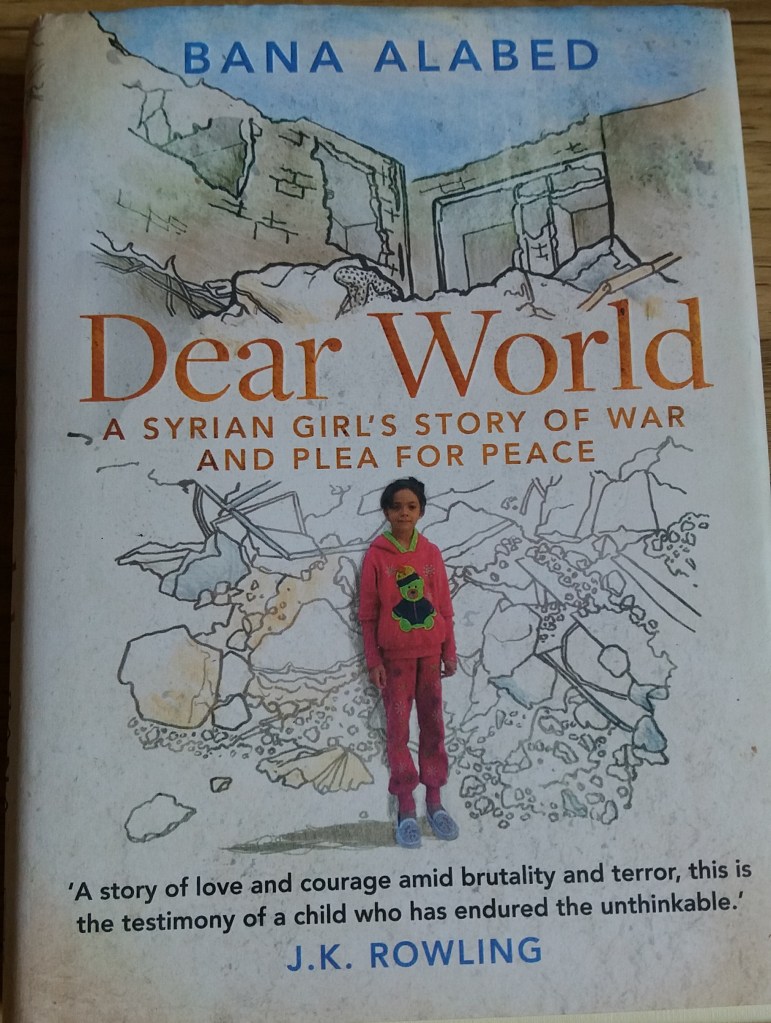
Refugee Book Blog: Dear World. A Syrian Girl’s Story of War and Plea for Peace by Bana Alabed

In 2016, eight-year-old Bana Alabed starting using Twitter to tell the world about what was happening to her family under siege in Aleppo, Syria. This book is her story about what happened to her and her family.

Originally I presumed this was a children’s book, but with the intense situations and colour photographs showing the brutal consequences of war, this is not one I would recommend for a young audience. Interspersed with letters to Bana written by Fatemah, her mother, Bana tells of her best friend dying, her home being specifically targeted by bombers and the arrival of her new baby brother against a backdrop of destruction and fear.

As a parent to an eight-year-old myself, I found this account absolutely heartbreaking and in places, difficult to read. In one of her letters, Fatemah says she now laughs about worrying about whether Bana was eating too many sweets: “What I wouldn’t have given for those to have remained my greatest concerns. To worry about what you ate, and not whether you would even have any food to eat”. Arguing about sweets is a regular occurrence in our house and this really put the situation into perspective for me.

With colour photographs accompanying the text, this book is very vivid, offering a child’s perspective on the horrors of living through war: destruction, violence and death. A reminder that war does not just touch the lives of adults, but that children too are caught up in the fighting. For anyone questioning why refugees are leaving, hand them a copy of this book and ask them if they would stay. Had this been written by an adult, it would be a powerful testimony. The fact it is written by a child makes it even more so.

Back to Refugee Week Book Blog

Uncategorized

Refugee Week Book Blog: Tomorrow by Nadine Kaadan

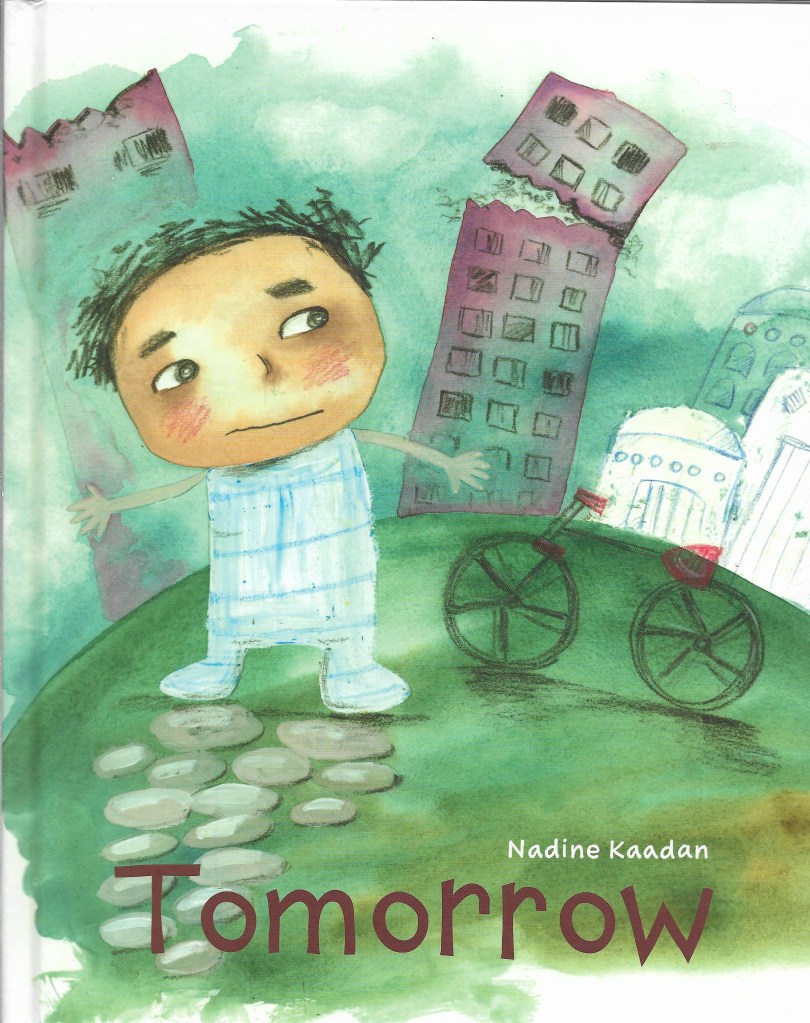
Starting now to focus more on the current refugee situation, my other recommendations today look at why people are leaving their home countries. A great book for younger children is Tomorrow by Nadine Kaadan, translated from Arabic by the author (Lantana Publishing).

This book tells the story of Yazan who can no longer go to the park. He no longer goes to school. He even starts to miss it “which was a surprise”. His parents are preoccupied but Yazan’s concerns aren’t about the news; he wants to go to the park. One day, Yazan decides he’s going to the park, takes his red bike and leaves the house alone. Everything is different to how it used to be. I won’t spoil the ending, but needless to say, he makes it home again safely.

In her letter to the reader, Kaadan begins asking, “Have you ever been stuck inside the house when you’re desperate to go outside?” Most children probably can. It’s really clever that she has taken such a serious issue and created story around a situation that a child who has never experienced war can understand. The illustrations in watercolour and pencil are beautiful and the colours really help to convey Yazan’s feelings.

One of my concerns had been about broaching this subject with (then) 4-year-old Emma and whether she would find this all a bit scary. While the pictures are at times dark and eerie and the buildings pictured are damaged, they aren’t portrayed in a particularly scary way.

What my kids had to say:

Dominic (8): It’s about a boy called Yazan. Everything around him is changing and he can’t go to the park because there are people fighting on the streets. It’s too dangerous. It’s important for children like me to read this book. It tells you what life is like in Syria. 

Emma (4): The shadows on the floor look like bad news. Someone’s broked (sic) the houses. It’s sad that Yazan can’t go outside. 

For more World Kid Lit suggestions, you can also visit the World Kid Lit website

Back to Refugee Week Book Blog

Uncategorized

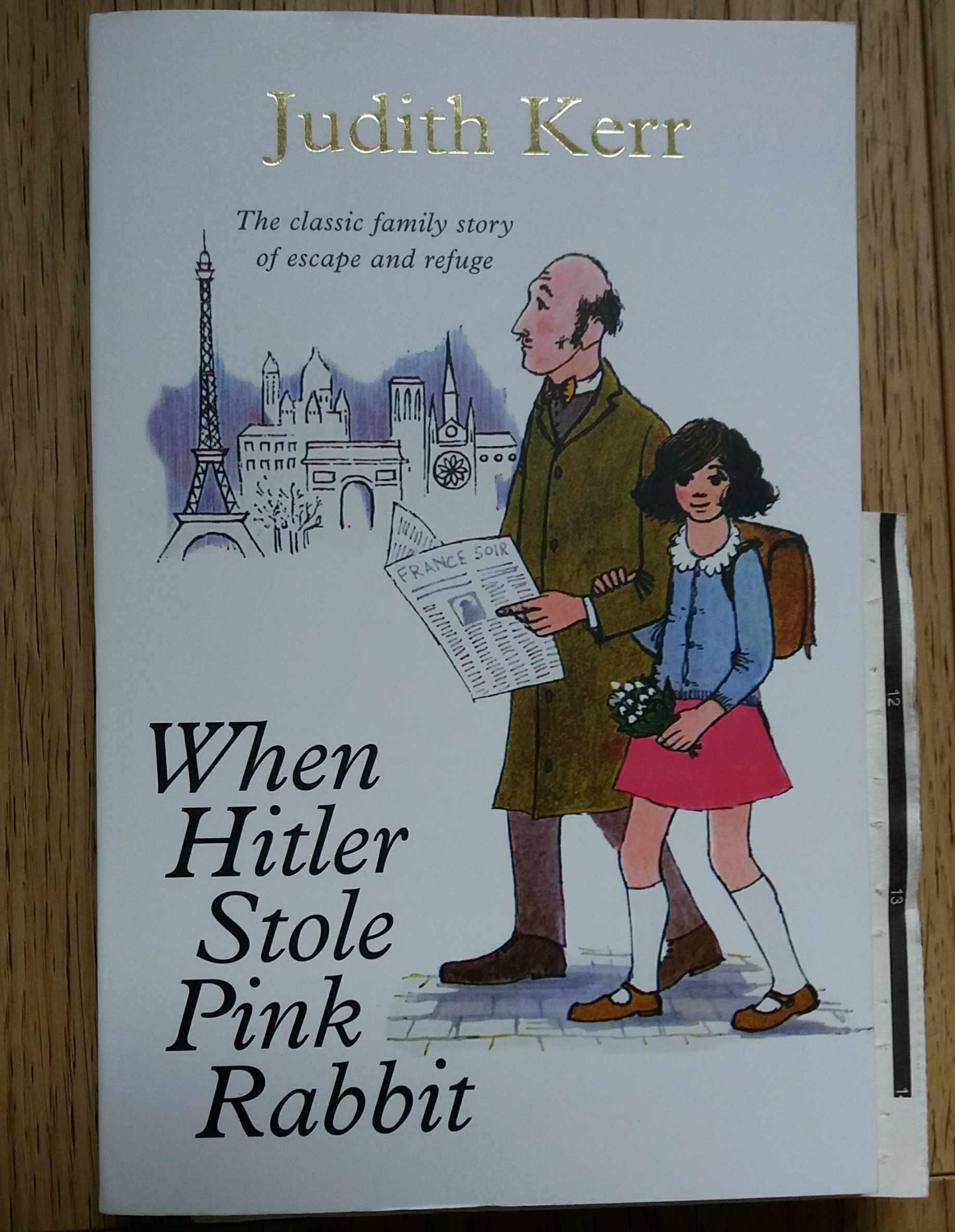
Refugee Week Book Blog: When Hitler stole Pink Rabbit by Judith Kerr

The theme of this year’s Refugee Week is “You, me and those who came before”, inviting us to “to explore the lives of refugees – and those who have welcomed them – throughout the generations.” Refugee Week is also a celebration of the contribution of refugees to our societies. And so, with all those facts in mind, what better way to kick things off than with the late Judith Kerr‘s autobiographical trilogy, When Hitler stole Pink Rabbit, Bombs on Aunt Dainty and Small Person Far Away. These books are a great introduction for older children to what it was like growing up as a German Jew during the Second World War and what it means to be a refugee.

The books follow Anna and her family as they escape from Germany just before the Nazi’s come to power, the first book accompanying her across the border to Switzerland, France and ultimately England. At this stage of her life, this is all a big adventure and this book is full of exploration, new experiences and different languages.

The second book jumps ahead in time and finds the family now settled in London just as the Blitz is about to start. There is great frustration on the part of Anna’s brother, Max, that while he feels he belongs, his nationality keeps preventing him from being treated just like everyone else. In this book we see the reality of a family with very limited financial resources, living with the constant threat of great uncertainty.

The third book in the series jumps forward again. Anna is now married, her father is dead and her mother is back in Germany. A phone call saying her mother is ill leads Anna back to Berlin, bringing her face to face with her childhood memories.

All three books are very engaging and offer children a personal glimpse into a situation which, for them, is practically gone from living memory. I will be putting the first book on my 8 year old’s reading pile; however book number two, in particular, has a lot of references to bombs and destruction, which is probably more suited to the older reader.

A great legacy from someone who herself arrived as a refugee.

Back to Refugee Week Book Blog

Uncategorized

Refugee Week Book Blog starts on Monday

On Monday, I will begin my Refugee Week Book Blog, recommending books on the topic of refugees and migration.

I aim to post at least two books a day, one adult title and one children’s book. These books can be used to inform ourselves but can also serve as a starting point for conversations with both adults and children. The picture books I will recommend this week are particularly important for opening our children’s eyes to the world around them and helping them to understand what may be happening around them.

Please join me as we stand in solidarity with refugees and asylum seekers around the world.

Uncategorized

Book Review: Caged by Duncan Annand

Caged by Duncan Annand together with Emma’s story

Today I am reviewing the wordless picture book Caged by Duncan Annand (Tiny Owl).   Helping me is my daughter Emma (in italics), who has really enjoyed this book. And I am 5.

The pictures tell the story of two men who are building a palace out of caged parrots. The pictures are impressive. Looking on is a bluebird who, after watching the palace grow and grow, decides to take matters into her own hands (or wings!). She takes it upon herself to free the parrots, catching the men in the cage in the process.

As a wordless picture book, the whole story is conveyed through the illustrations. Duncan Annand’s use of colour is very effective, with line drawings for the men, the cage and surroundings contrasting with the bright prime colours of the birds.

We don’t often look at wordless picture books, so as Emma opened the first page, she looked at me asking “where are the words?” I suggested that she was being given the pictures but that she had to come up with her own story. And that was it, she was off! She got her paper and pencil out and set about creating her own story. She’s currently written about 4.5 sides of A4, all written her beautiful five-year-old handwriting complete with very phonetic spellings. It is amazing! She has been so inspired by the pictures and keeps finding new aspects of the story to add. She’s wanted to take Caged with her everywhere she goes so she can keep on writing.

I LOVED IT   YES I DIID I LOVE IT     SO        MOOCH

With my involvement with Derbyshire Refugee Solidarity, I’m also interested to see that Caged has been chosen by IBBY UK to be included in the library at Lampedusa, Italy, where there are large numbers of refugees. I can see the appeal, allowing people from different cultures and with different languages to interact with the illustrations in their own ways.

Many thanks to Tiny Owl for providing us with this copy of Caged.