Uncategorized

World Kid Lit Book Review: Cuentos Criminales by Pedro Mañas and David Sierra Listón

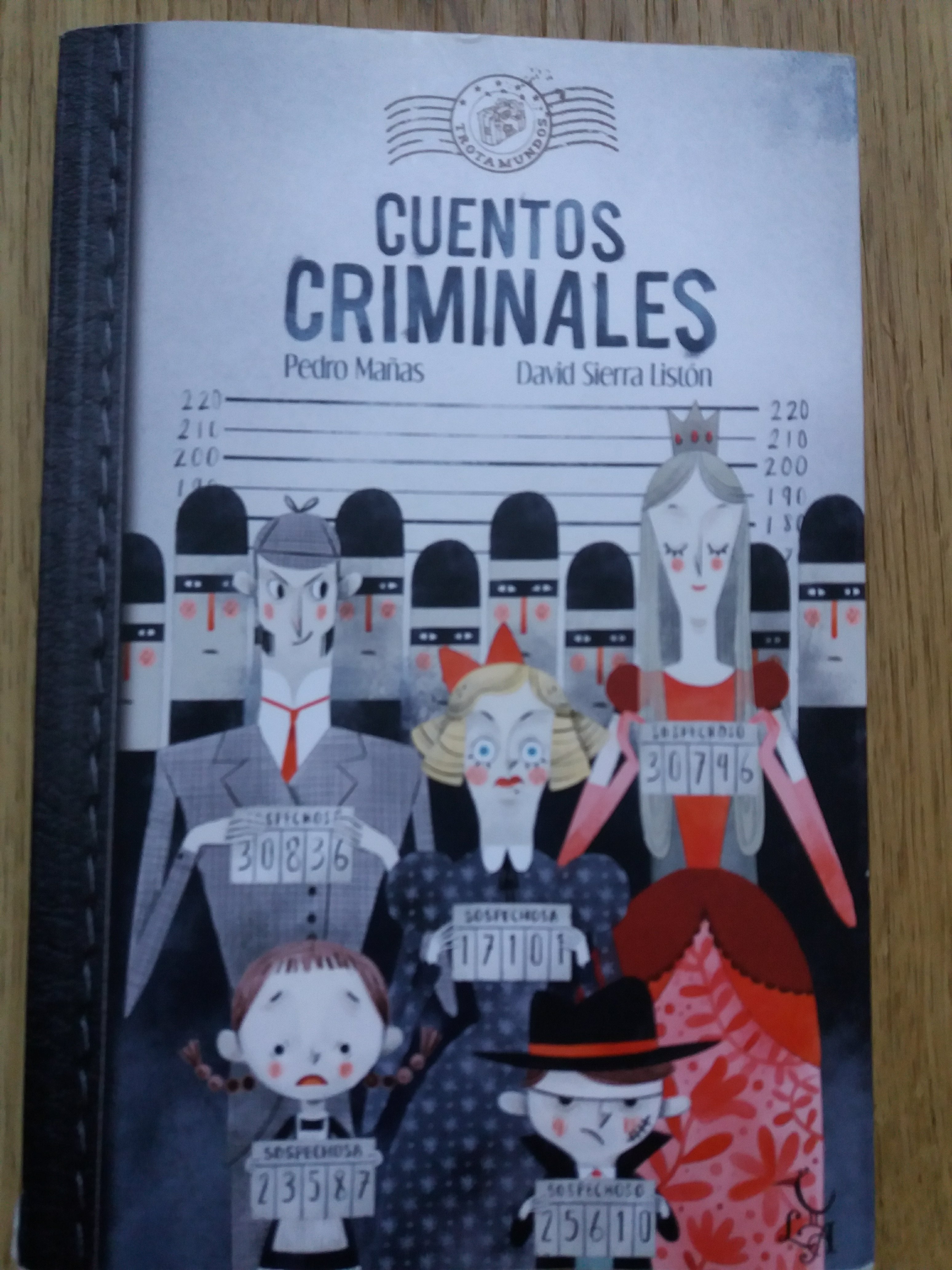
The book I’m reviewing today is a hilarious illustrated middle-grade book from award-winning Spanish author Pedro Mañas and illustrator David Sierra Listón: Cuentos Criminales (Editorial Libre Albedrío). I’ve spent the last year or so working with this book for my MA Dissertation and I have to say, it’s a great book!

The premise for the book is a detective-turned-writer who shares with the reader all the gory details about the cases he has worked on throughout his career as a detective. But this is no serious crime writing; this will elicit belly laughs at the ridiculous situations the detective finds himself in as well as the puns and witty wordplay woven in by Mañas.

The cases take place in cities both around the world and in imaginary places. Some cases are based in reality, adding a twist, for example, to the real-life scam where a man sold the Eiffel Tower for scrap metal. A later case involves Sherlock Holmes in London. There is a real sense of adventure and fun.

The illustrations and layout of the book also really draw the reader in. The text is occasionally written as if in a notebook, at jaunty angles on the page. The colourful pictures throughout the 252 page book are a real bonus and something that isn’t often seen for this age group – full-colour images have often been replaced by black and white line drawings by this stage.

All in all it’s a fantastic book that will keep your children giggling!

Back to Book Reviews

Uncategorized

I passed my Masters Degree in Translation Studies!

Just a short blog post today to celebrate the fact I’ve passed my MA in Translation Studies. Not only have I passed, but I have been awarded a Distinction – hurray! It feels like it’s been a long time since I began the course, way back in September 2015 and I don’t officially graduate until January 2020, but it feels amazing to have finished and to know that I can now move on to the next stage of my career in translation.

Uncategorized

Inspiring the Future at a Derby inner-city school

A while back I was invited to participate in an event organised through Inspiring the Future. Today was the day and so, armed with Harry Potter, Pokemon and Disney’s Let it go, I headed to a junior school in the inner city of Derby.

Going in, I knew that this particular school had a high volume of children with Asian and Eastern European backgrounds. What I recognise from this is the language skill base these children have to offer. I’ve often heard people say that “X child doesn’t speak English at home.” I’d like to challenge that perception and ask “well what do they speak?”

I spent my time circulating around three Year 5 classes (9/10 year olds) and the linguistic spread was astounding. Asking what languages the children spoke, we discovered Urdu, Punjabi, Hindi, Romanian, Polish, Greek, Spanish, Russian, Arabic, Kurdish, Latvian, Swedish, Italian – what a mix!

We talked about what jobs we could do with language skills, discussing languages in a business setting. We looked at book translation, dubbing and subtitling – they particularly enjoyed Let it go in 25 languages. We also talked about interpreting in schools and hospitals, settings where some of the children already have experience of meeting interpreters, or indeed sometimes acting as interpreters themselves. A Google search had revealed that in Derby, the “in demand” languages were many that were sitting on the floor in front of me.

I hope that if nothing else, the children from today’s sessions leave knowing that their language skills are an asset to them. For the rest of the world, multilingual is normal. Here in the UK, language take-up in schools is dropping (another article about this was published just today). These children are our future linguists and should be cherished and encouraged. It’s not “just” a language they speak at home.

To volunteer your time to inspire the future, please register with Inspiring the Future.

Uncategorized

Refugee Week Book Blog: There’s room for everyone by Anahita Teymorian

I want to finish this week-long look at books focusing on refugees and migration with this uplifting picture book by Iranian writer Anahita Teymorian (Tiny Owl). The message is quite simple, there’s room for everyone!

At the back of the book, Anahita describes the day she sat shouting at the television about all the awful events happening in the world. Afterwards, she sat down and started writing down all the things she had said, molding them to become this book. The detail in the illustrations in this picture book is fabulous – there are whales with handbags, giraffes with necklaces and bracelets. We enjoyed giggling at some of the pictures, the birds on the washing line (my favourite is the last bird on the right) and the noses sticking out of the tanks.

The little boy starts by pointing out how all around the world, there is enough space for all the animals, all the stars, all the sea creatures but that as he grows up and travels, he sees people fighting for space. Now he’s grown up, his final message is a conspiratorial secret to share with the reader: “if we are kinder and we love each other then, in this beautiful world, there’s room for everyone”. What an uplifting message for the world!

What my daughter had to say:

Emma (5): I like this book because the drawings are really good. I like the elephant holding a yo-yo!

For more World Kid Lit titles, you can also visit the World Kid Lit blog.

Back to Refugee Week Book Blog

Uncategorized

Refugee Week Book Blog: Do you speak chocolate? by Cas Lester

This is an English-language mid-grade novel that introduces year 7 pupil Jaz to a new classmate, Nadima, who has recently arrived with her family from Syria.

At first Nadima doesn’t speak any English and Jaz wonders how they are going to communicate. Enter the mobile phone and emojis. By using emojis of various items and a thumbs up or thumbs down, Nadima and Jaz are able to communicate. With a positive “like” to chocolate, Jaz shares her chocolate with Nadima and so the friendship is forged.

Over the course of the story, Jaz makes several attempts to “help” her new friend, most of which blow up in her face. Lester cleverly weaves into her story acts that we might be tempted to do to “help”, for example, raising money for a particular family because they are “poor”. She explains through her narrative that Nadima’s family don’t want charity, they are proud people who want a chance to be respected in their new home.

I thought this was a really insightful story to help youngsters understand how they can help their new peers and to explain how some of the things we might want to do are actually inappropriate.

For more World Kid Lit titles, you can also visit the World Kid Lit blog.

Back to Refugee Week Book Blog