Blog

Uncategorized

World Kid Lit Challenge Day 16

For today’s book, we’re back in translation with Laura’s Star by Klaus Baumgart, translated from German by Judy Waite (Little Tiger Press).

Emma: I like the shiny star. 

Jenna (one of our friends): I felt very sad for Laura. 

Laura is a lonely little girl who wishes she had a friend. Looking out the window one night she sees something fall from the sky. She goes outside to investigate, finds a broken star on the ground and takes it home to look after. She enjoys playing with the star but the next morning she can’t find her new friend, leaving her bereft. That evening, she realises the star had been there all along but out of its natural environment, the star is beginning to die. She realises she needs to send the star back to where it comes from, so sacrifices her favourite balloons to help the star on her way.

It would be easy to overlook this book in favour of other flashier books and titles but actually the this is the sort of book I want my kids to read. Baumgart could have made this a celebration of pinkness and frilliness, Laura in her princess palace complete with tiara. But he hasn’t! In the day, Laura wears green and orange and at night she has blue and white striped pyjamas – not a pink sparkly wand in sight! Her bedroom has toys littered around it, (just like ours!), there’s an open book on the bed and the toys on view are a real mix of rockets and dolls. When mum and dad try to cheer her up, it’s dad who’s wearing the apron and carrying the jelly .This is the message I want my children, both Dominic and Emma, to receive – toys are toys, colours are colours and cooking can be done by both sexes!
Uncategorized

World Kid Lit Challenge Day 15

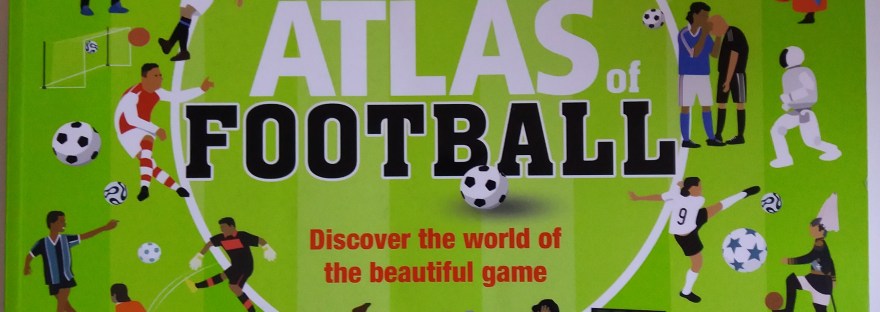
Today’s it’s Dominic’s birthday so he gets to choose his favourite book to share. We’re back on the beautiful non-fiction with the Atlas of Football by Clive Gifford and Tracy Worrall (Egmont).

Over to Dominic:

At the beginning I didn’t think this would be very interesting but then I started reading it and I thought it was actually really interesting. You get to learn things about the world and it is a tiny bit crazy. It tells you facts like how many toilets Wembley has – 2618! It is also a bit funny because it tells you ridiculous thing like divers were playing underwater football in a Sealife Centre in Germany. Kazan in Russia was filled with water for the diving competition and it hosts the largest TV screen in the world. I also know about women’s football in Canada as well. I enjoy flicking through the book. I have probably now read each page at least a hundred times and I think I’ve read every fact in the book now. 

We bought this one towards the end of the World Cup. Dominic had really enjoyed talking about the different teams from different parts of the world. This book has been a great companion along the way and has definitely held his interest. The book works its way around the world, each double spread focusing on a different geographical area. The text is dotted around the page in short footballing facts, interspersed with illustrations of places or people. I like the fact that it is a mixture of historical facts and current events, offering information about men’s and women’s football equally. I can imagine that this book would be particularly appealing for reluctant readers because each chunk of text is really short. You can dip in and out of the book and read just a short snippet of information every time.

Last words from Dominic: It’s an amazing book and I’d recommend it to my friends. 


Today’s books is not in translation; however, it does teach our children about the world hence why it’s on our list. We came across this one on a thread started by Rob Smith about beautiful non-fiction for kids. Introducing World of Cities by James Brown (Walker Studio).

Dominic: It is interesting because it shows you different landmarks in cities around the world and it tells you lots of facts about them. The book is nice and colourful. The writing is in different shapes, for example, in the moon, on the bus, on Big Ben. The writing on each page is different. Each page tells you how many people live in each city. Shang Hai in China is the biggest with around 24 million people.

The large-scale front cover impresses right from the start. Bold and striking, it leaps at you from the shelf. Each double spread turns 90 degrees to display stunning artwork. Each individual image could easily be used as a poster. The book covers 30 cities from around the world, including places like Sydney, Dubai, Tokyo, Amsterdam and Cape Town. As Dominic mentions above, facts are cleverly woven into each page: along the edges of the page border, under bridges, on boats, along a surf board. Dominic loves non-fiction and he has spent hours poring over this book, turning his head this way and that to read all the finer details and then sharing what he has learnt with us. This is a really special book!

Back to World Kid Lit Challenge

Uncategorized

World Kid Lit Challenge Day 14

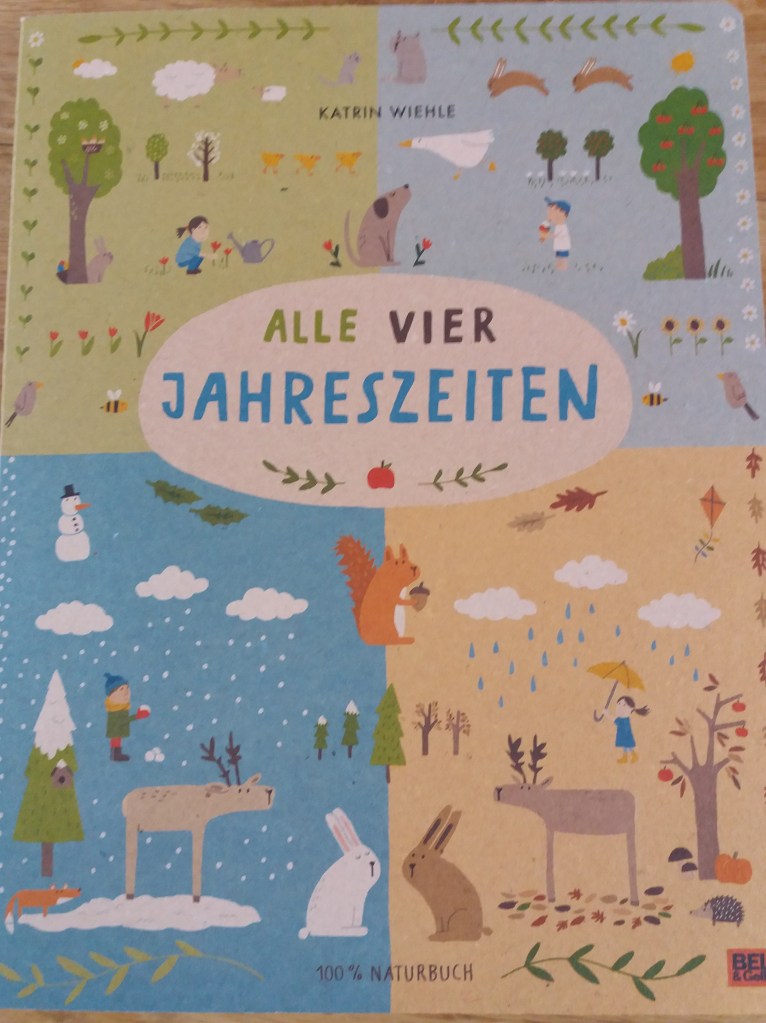
Today I’m looking at another fabulous book that is yet to be translated: Alle vier Jahreszeiten (My Four Seasons) by Katrin Wielhe (Beltz &Gelberg).

Emma: I like the tulips and I like the pumpkins and I the grapes and the conkers. I like the dragon. There’s loads to look at. My favourite picture is winter because there’s a cat ice-skating. (The German for kite is Drachen which also means dragon. The kids thought this was funny, hence Emma’s comment here about the dragon).

Dominic: I like the pictures because they are very detailed. It’s a useful book because it tells you German words. It tells you lots of interesting things like flowers. The pictures tell you what the word means if you don’t know. 

I found this on a friend’s bookcase and was immediately drawn to it. It is a beautiful large-scale board book for young children. Each double spread depicts a glorious scene set in a particular season, with individual words picked out on the page. Spring, for example, has a title reading “Im Frühling wird es draussen grün” (In Spring, everything outside turns green) and picks out words like Easter basket, watering can, bicycle, dandelion. Turn over the page and we find drawings of 9 different spring flowers and their names, we see the life cycle of a daffodil bulb being planted, following its growth through to flowering and there are illustrations of animals with their young, the names included underneath. And so it continues throughout the whole year.

I’m sure many of you have heard of the idea of the “lost words”, those words that were removed from the Oxford Junior Dictionary for “not being used enough to merit their place the dictionary“*. These words included acorn, bluebell, dandelion, fern, heron, kingfisher, newt, otter, and willow – words relating to nature. This book introduces many of these words to a young audience.

The other aspect of this board book is that it refers to itself as “100% Naturbuch” (100% Natural Book). It is printed on 100% recycled paper using eco-friendly inks. What a great book to publish in the current climate.

Back to World Kid Lit Challenge


Uncategorized

World Kid Lit Challenge Day 13

Today we are looking at Shola and the Lions by Bernardo Atxaga, illustrated by Mikel Valverde (Pushkin Children’s). This book first appeared in Basque and was translated by the author into Spanish. Margaret Jull Costa then brought it to our eyes by translating it into English.

Synopsis today by Dominic:

A tiny white dog pretends to be a massive lion but she can’t be a lion because a lion is a type of cat and she is a dog. So she tries to scare people off but she can’t because she is just a dog and not a lion. She tries to hunt her own dinner but she couldn’t so she went home and had her own food that her owner gave her and she realised she wasn’t a lion at all. 

Emma: Shola thought in the mirror that she was a lion. She isn’t really a lion. 

This is a lovely book, bridging the gap between picture books and longer reads. The 48-page story is beautifully illustrated in colour and I love Shola’s many different expressions. The printing also has a great quality feel to it. The humour is great (Shola dying her fur in the bathroom surrounded by bottles) but the stand-out line for me in the book comes towards the end. Having been convinced she was indeed a lioness, she eventually admits “I made a mistake”. I think that’s quite an important thing for children to read; Shola made her mistake but Sr. Grogó accepts her back, admittedly with a bit of teasing, but nonetheless, the books leaves us safe in the knowledge that Shola is now safe back where she belongs. For anyone thinking this may be the book for them, there’s another three Shola stories to go at once you’ve finished this one!

Uncategorized

World Kid Lit Challenge Day 12

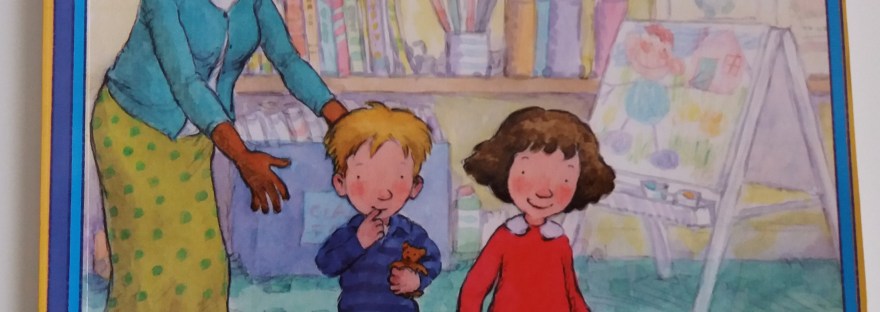
Today’s choice honours the fact it’s Emma’s first day at primary school today but also offers an opportunity to explore something a little different. Today’s book is a dual-language book called Tom and Sofia start School by Henriette Barkow and Priscilla Lamont, translated into Malayalam by Dr. Lizy James (Mantra Lingua).

Emma: Tom makes some new friends and I’m going to make some new friends too. 

This book was sent to Emma by a friend whose husband is a Malayalam speaker. In the book, Tom and Sofia are getting prepared for their first day at school. The story follows them on their journey to school and the different experiences they encounter on their first day – familiar scenes for many children. Each section of text on a page is written in both English and Malayalam and we enjoyed looking at the beautiful, unfamiliar script, wondering which words corresponded to which English words. We enjoyed discussion about how other people write and about other languages.

I researched a bit more about Mantra Lingua and on their website they state their publishing philosophy is to “reflect the multilingual nature of today’s society”. In this book this is indeed apparent: the class Tom and Sofia go into has a real ethnic mix of children, some wearing religious attire. Having bemoaned the lack of BAME characters earlier in the challenge, there is no shortage in this book. And it goes further still, including a boy in a wheelchair. What I particularly like is that none of these children has any great attention drawn to them. They are just normal members of the class.

I was also interested to read on Mantra Lingua’s website about their expansion in the German market using books to help integrate new arrivals in the country, combining German with languages like Arabic, Turkish, Farsi and Kurdish. The power of books!