Blog

Uncategorized

World Kid Lit Challenge – What we have learnt

So we did it. 30 books in 30 days. I’ve definitely enjoyed it and I think the kids have too. Sitting here today with an empty house I’ve got time to reflect on the challenge and what we have learnt.

I like to think of myself as a linguist. I’ve been involved in languages for years and recently made the switch to translation. I’ve always loved books and made a point of ensuring we have lots (and lots) of books at home. I’d been down the lists of what they “should” be reading and made sure we have some of those too. As I started this challenge, I thought it would be easy to find suitable books in among my shelves. How wrong was I?! We had about 5. Even as someone who cares about what their kids read and about languages, I still haven’t been representing different cultures, different perspectives and different people. Well, we do now!

And it’s been interesting to see how Dominic and Emma have reacted to them. For the most part, they haven’t blinked an eye. They have just accepted these books as books that they either like or don’t like, not because they are set elsewhere, but just because we all have different tastes. While I have searched for books specific to the challenge, they just enjoyed them as stories, particularly Emma.

That saying, I have loved some of the discussions I have had with Dominic. Being that bit older, we’ve been able to discuss concepts and situations a bit more in depth. Some of the titles, those dealing with war and fleeing, I may well have shied away from, but both kids have embraced these books. Emma now regularly asks to read The Journey and Mama’s Nightingale.

I’ve also had conversations with other people about the ways that cultures and people are depicted in books. My friend from Zimbabwe told me she had been inspired to go and hunt out some African folktales to share with her children and that they were really enjoying sharing them together. That sort of conversation makes this whole challenge worthwhile.

A review of our challenge is being included in the Nov/Dec issue of the The Bulletin from the Institute of Translation and Interpreting here in the UK. Hopefully we can inspire others to read some of the titles we have enjoyed.

So what next? One friend suggested I should continue the reviews, so I will. Not at the same rate, but I will aim to post at least one review a month of a World Kid Lit title. And I am on the look-out for new, untranslated material to prepare as samples with the hope of convincing a publisher to commit to offering more translated fiction to our English-speaking children.

Thanks for joining Dominic, Emma and me on this global journey through books!
 

Uncategorized

World Kid Lit Challenge Day 30

We’ve made it! Day 30! And it just so happens to coincide with International Translation Day, celebrating the work of translators across the world.

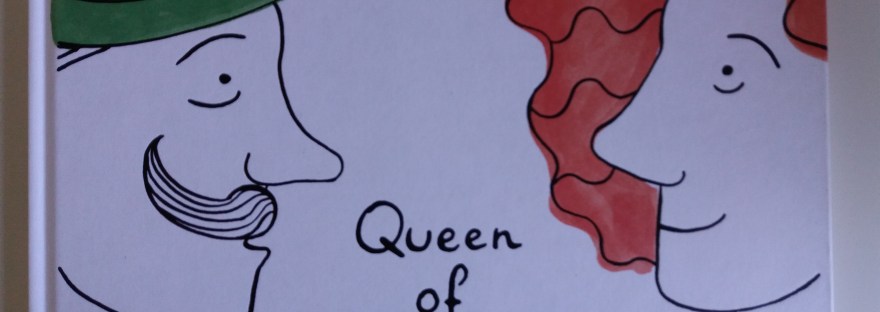
The last book in our 30 day World Kid Lit Challenge is Queen of Seagulls by Rūta Briede, translated from Latvian by Elīna Brasliņa (The Emma Press).

Lottie (Dominic and Emma’s cousin – 6): I thought it was really good. The best bit in the book is when he was trying to show her how to love seagulls.

Dominic:  It was a bit awkward that she forgot that she was the Queen of Seagulls. The writing was a bit hard to read in the middle but it looked nice. The pictures only had a few colours in – I liked them!

I went the London Book Fair this year and attended a talk about picture books, where The Emma Press was discussing this book. I felt inspired to come home and order it.

The book tells the story of a lady called Renata (it’s fair to say she’s quite a grumpy lady) who is enraged by seagulls and cannot understand why they won’t leave her alone – it’s as if they’re trying to tell her something. Just as she is despairing at the arrival of a nuisance neighbour, the narrative cuts to a time gone by, cleverly using a different font to highlight the distance between the narrative voices. This middle section tells of her previous life as Queen of Seagulls and how she came to be where she is. All of which in the current narrative, she has no memory.

As the story unfolds back in the present, an accident involving the nuisance neighbour, a fishing rod and an accordion brings the two together with music acting as a catalyst to unlock her memories. Suddenly, she understands everything and can now hear the message the seagulls have for her.  

The illustrations in this book are wonderful. They are simple line drawings with a splash of colour yet there is such detail contained within them.

Many thanks to everyone who has been following this challenge. Tomorrow I’ll be posting a bit about what we have learnt over the course of the last month and what impact this may have on our reading choices in the future. Look out also for a round up of the challenge and some of our favourite books in the November/December issue of The Bulletin from the Institute of Translation and Interpreting.


Uncategorized

World Kid Lit Challenge Day 29

We’re nearly there! The penultimate book on our World Kid Lit Challenge is an American book: Runny Babbit by Shel Silverstein (HarperCollins).

Dominic: We listened to this in the car and it made us all laugh. I tried to read some out loud but kept on getting it wrong.

Runny Babbit is written in English, but not perhaps as we know it! Cleverly using spoonerisms, swapping the first letters around, Silverstein creates poems that are both nonsensical yet understandable all at the same time.

This book came with a CD, which as Dominic says, we listened to in the car. The speed that the narrator read these poems with is astounding and really makes these poems come to life. As my husband said, this book is one to be read out. On the page, yes, the poems look funny, but the joy really comes when they are heard aloud. I found if I tried to untangle and understand each one as it went along, I just ended up getting lost and it was much easier to just go with the flow and let it wash over you.

A couple of favourites are Runny’s Mancy Feal and Runny’s Rittle Leminders. In these poems, there would be may repetitions of the same word; however the preceding word changes each time, so for example:

Runny lent to the wibrary,

And there were bundreds of hooks-

Bistory hooks, beography gooks,

And lots of bory stooks (From Runny’s Heading Rabits).

This is definitely one to look out if you want something a bit different! I love the fact we wouldn’t have come across this had we not asked around for recommendations for our challenge. Thanks to Emma Edwards for this one!


Uncategorized

World Kid Lit Challenge Day 28

Another new title in translation today: Inside the Villains by Clothilde Perrin, translated from French by Daniel Hahn (Gecko Press).

Dominic: I really like the witch. She looks like a normal person but then you open all the flaps and you find out she’s actually an evil witch. And have you seen that the wolf’s jaws open and close?

Erin (a friend – 7): I loved the pictures and looking under all the flaps and in the pockets and I liked turning the big pages the wrong way to find the “More about me” bit.  

Eloise (Erin’s mum): It’s like a pantomime in book form. There are bits for the children to laugh at but there are some bits that the adults will get on a different level. It’s so much fun!

Wow! You cannot fail to be impressed by this book, both in size and quality. This sophisticated picture book presents three infamous characters from the world of the fairy tale: the Giant, the Witch and the Wolf. The unique design has flaps to look under and strings to pull, revealing incredible, intricate details. You then fold out a page on the left-hand side to reveal a section entitled “More about me” and a story, displayed as if in  a newspaper.

There is so much to look at and read. Dominic was entertained for ages, working out what opened where and what could be pulled out. A word of caution though, the flaps are not the most robust and while it is great for teaching children to treat books with respect, it probably isn’t one for little fingers to be left alone with.

It’s also an interesting discussion to have about who picture books are aimed at. The complexity of the pictures and the register of the language suggest that this is aimed at older children. As children get older and the illustrations begin to disappear from their books, it is great to come across such an engaging book. It draws the child in and just begs to be read.

This really is a book to treasure for years to come.


Uncategorized

World Kid Lit Challenge Day 27

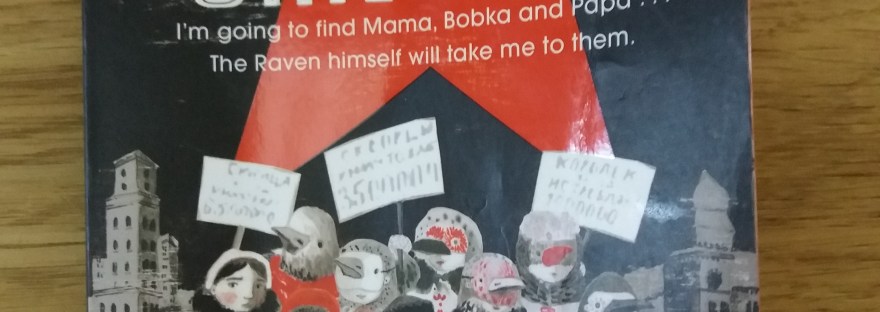
Introducing a brand new title in translation: The Raven’s Children by Yulia Yakovleva, translated from Russian by Ruth Ahmedzai Kemp (Puffin).

This book looks so appealing. The artwork on the cover is bold and to add to it, the edges of the pages are red which makes it really distinctive.

The story centres around Shura, a seven-year-old, whose life in 1930s Leningrad is thrown into turmoil when his parents and younger brother disappear one night. Shura and his sister are left alone and are turned away by every adult that they seek help from. Their home and belongings are appropriated by others as they are chased off and become almost invisible. Shura resolves to find his parents.

The first part of the book is quite mischievous in places and highlights the innocence of children. Shura is oblivious to many of the dangers surrounding him and announces proudly to the world: “My papa’s gone away on a business trip! He was called urgently!”, which the listening world interprets as “The Black Raven came for our neighbour last night”.

Another poignant moment is where a neighbour hands over a purse containing “over a hundred roubles”, which the children’s mother has left for them. Shura and Tanya are initially confused and believe they have been left this money so they can go out and enjoy themselves. They resolve to go out for breakfast and then to the cinema. As an adult reading this, it really tugged at my heart strings knowing that the world as they knew it was soon to come to an end as they realised how serious their situation was.

In the second half of the book, Shura has been captured and imprisoned with many other children. Their heads are shaved and we read of the conditions he and the other children are kept in. The tone of the book becomes much more serious as Shura begins to follow the routine imposed on him, forgetting his previous life. A chance event, however, reawakens his memory and he takes an opportunity to escape. But it’s still not plain sailing and Shura has to overcome both physical and mental challenges to rescue his little brother.

The imagery in this book is really evocative. Ears and eyes appear and disappear in walls, visualising the idea of being watched and listened to. I loved the bit where a lady stuffs breadcrumbs into one of the ears in order to muffle their voices. It does deal with quite a dark subject and, at times, it feels quite scary, as indeed living in such a place at this time must have been. Along with the eyes and ears, the author also uses elements of magic realism with Shura and Tanya able to communicate with talking birds and rats.

I particularly liked the note from the translator at the back where we are given some more information about the process of how to present such a story to a readership with little or no knowledge of these events. I can also imagine the discussion questions included being useful to use as a launchpad for discussion about this period and the book.