Blog

Uncategorized

Refugee Week Book Blog: Crossing the sea with Syrians on the exodus to Europe by Wolfgang Bauer, trans. Sarah Pybus

Crossing the sea with Syrians on the exodus to Europe by Wolfgang Bauer, translated from German by Sarah Pybus (And Other Stories).

In 2014, award-winning journalist Wolfgang Bauer and photographer Stanislav Krupar go undercover, joining a group of Syrians trying to get across the sea to Europe. Witnessing first-hand the smuggler gangs, the desperation, the anxiety and the very real dangers of drowning, this is Wolfgang Bauer’s account of his attempt to cross the sea.

It is a deeply moving story of human desperation and determination. These are not just facts and figures we hear about on the radio and read about in the paper; these are people with lives and families.

After days of travelling across land and hiding in flats, waiting for the right moment to cross, Wolfgang and Stanislav’s attempt to cross the sea ends in arrest and deportation. A poignant moment is where Wolfgang and Stanislav have revealed their true identities and Wolfgang observes that “in a matter of seconds, those papers transformed us into different people. From prisoners to privileged frequent flyers”.

After their deportation, Wolfgang has to follow his friends’ journeys from afar. One of the men, Amar (not his real name), makes so many attempts to cross the sea, thinking all the while of his wife and children who will follow him once he makes it. Time and again his efforts are thwarted and he returns to the same cheap hotel to plan his next move. When he finally made it across, having travelled to Africa and taken a flight to Germany on a false passport, I was moved to tears.

We are also told of the journey of brothers Alaa and Hussan, who get onto a boat and make that perilous crossing. In the description of that crossing it is plain to see the panic, the fear, the despair of those on board and the realisation of how near death may be : “We might die out here.”

The book finishes with an impassioned plea from Wolfgang Bauer: “Stop forcing men, women and children onto the boats. Have mercy”. Will the world take note?

Back to Refugee Week Book Blog

Picture Books, Reviews

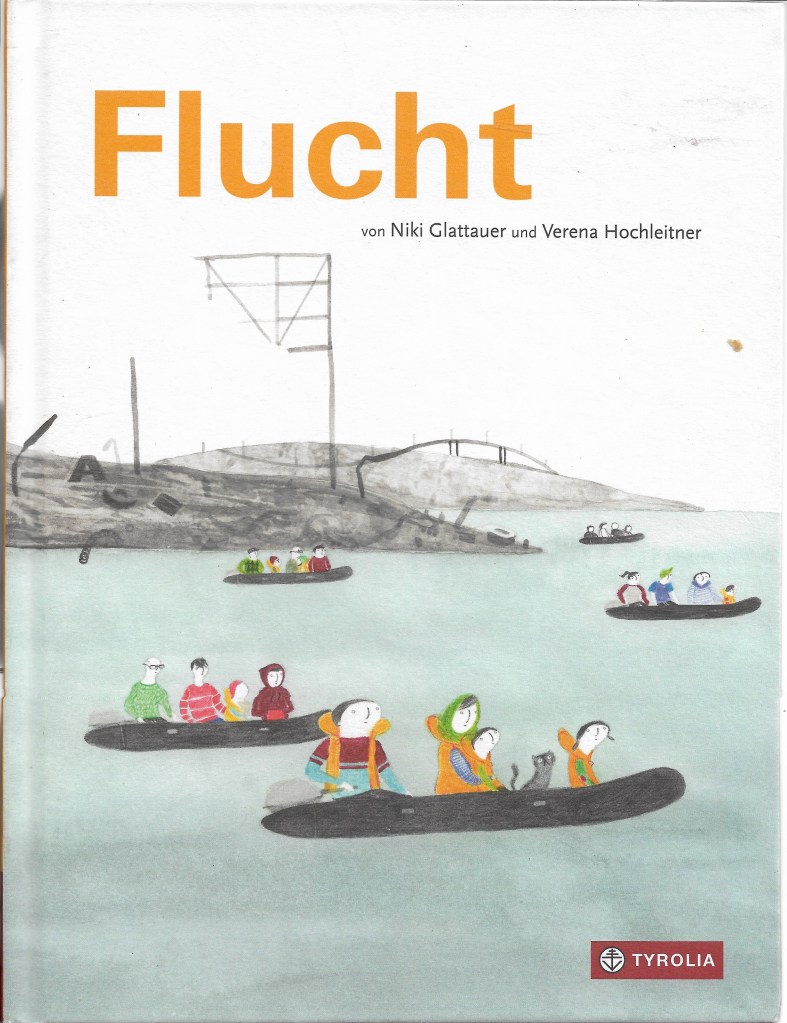
Flucht by Niki Glattauer and Verena Hochleitner

In 2018, my kids and I carried out 30 day challenge reviewing 30 books in 30 for #WorldKidLitMonth. This was one of the books we looked at and I think it’s one that’s worth revisiting for #WorldKdiLitMonth 2020. This picture book comes from Austria and is yet to be translated: Flucht (Flight) by Niki Glattauer and Verena Hochleitner (Tyrolia Verlag).

This book is a little unusual in as far as the story is told from the cat’s perspective. His name is E.T. like the alien in the film who calls for help. E.T. leads us through the family’s preparations to leave their war-torn home and make the journey across the sea. We are told and shown an illustration of what is on Daniel’s packing list:

1 pencil case with pencils, crayons and felt-tip pens, 1 notebook, 1 bag of Lego Minecraft, 3 shiny stones, 1 mobile phone, 1 laptop, 1 pair of jeans, 2 pairs of shorts, the Messi T-shirt, 5 other T-shirts, 1 black leather jacket, shoes with the green flashing lights, 1 other pair of shoes, pants and socks, 4 large bottles of water, 1 small envelope of documents and
1 large envelope of old photos. 

Seeing these items laid out with the rucksack underneath really brought it home for me how very little this family are taking with them, but also what they are taking. For Daniel, the Lego and his Messi T-shirt, but photos, a phone and a laptop. Sometimes we have an image of refugees as people who had nothing to begin with. We perhaps picture them as poor, living in a rundown hut in the middle of nowhere. Of course, some people do live like that, but many come from societies which are, or were, just like ours. And if I were leaving in a hurry, I know I’d grab my mobile phone – it’s a map, a torch, a phone, a camera and I can use it to access my emails – an essential piece of kit!

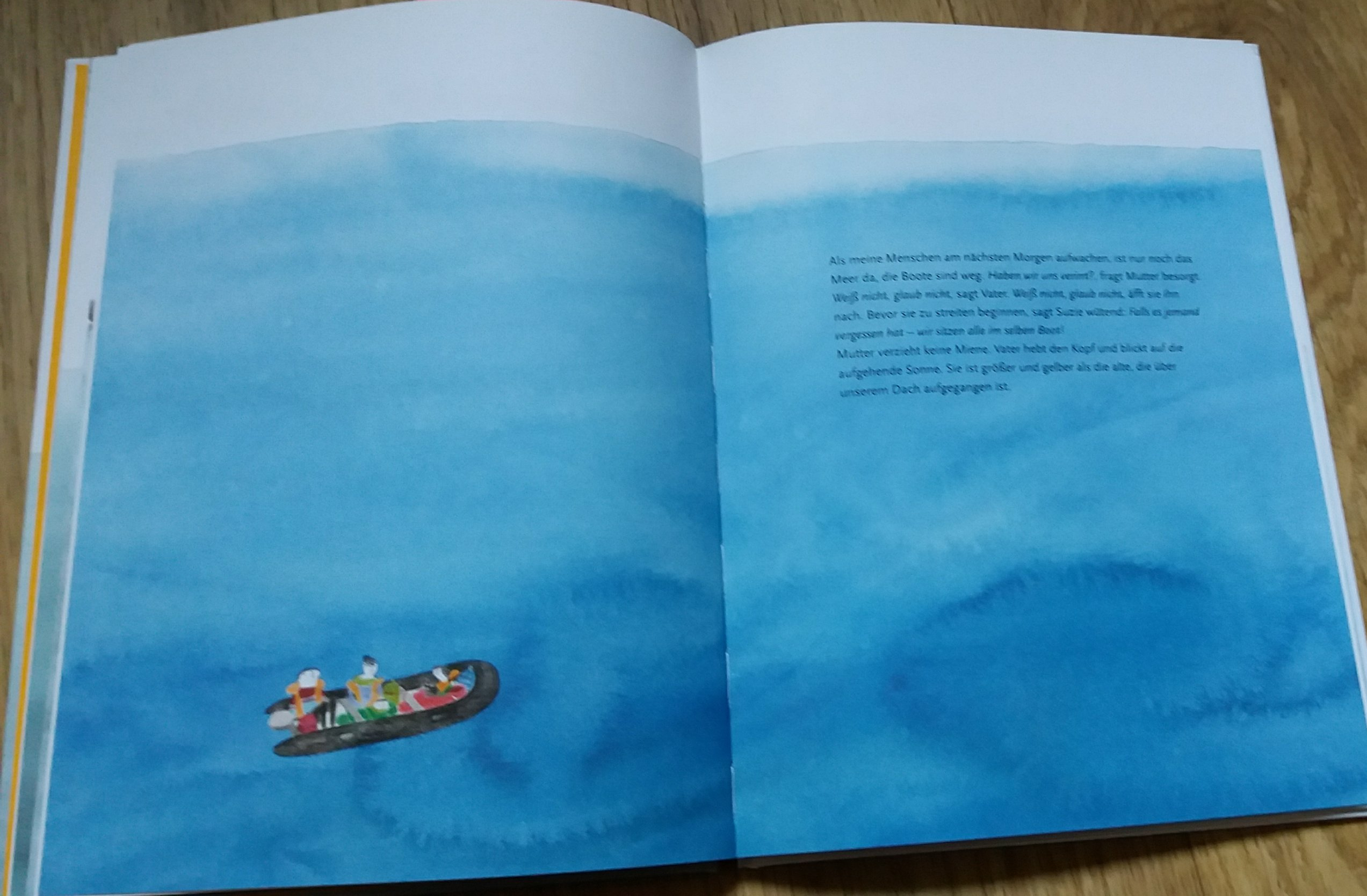
The illustrations are very powerful – one page shows a single small boat on an expanse of blue.

What is really powerful about this book comes right at the end (spoiler alert!). Throughout the book, we as the reader make assumptions about who these people are and where they come from. Perhaps it’s Syria, perhaps it’s Africa. But Glattauer and Hochleitner turn this on its head, revealing that the family are not fleeing from Africa to Europe, but from Europe to Africa. It challenges us to consider how we would respond to such events: what would we do? And I think it’s really important to do this, to put ourselves in other people’s shoes and empathise with them.

What my (then) eight-year-old son had to say:

They are leaving their home because their country is in war. It must be bad where they are living. They are not taking much stuff with them. I think travelling on the sea must be a bit scary.

For any interested publishers, the English rights for this book are still available from Tyrolia Verlag and I have a mocked up book with my translation available. Please get in touch!

For more World Kid Lit titles, you can also visit the World Kid Lit blog.

Back to Refugee Week Book Blog
Uncategorized

Refugee Week Book Blog: The Gurugu Pledge by Juan Tomás Ávila Laurel (trans. Jethro Soutar)

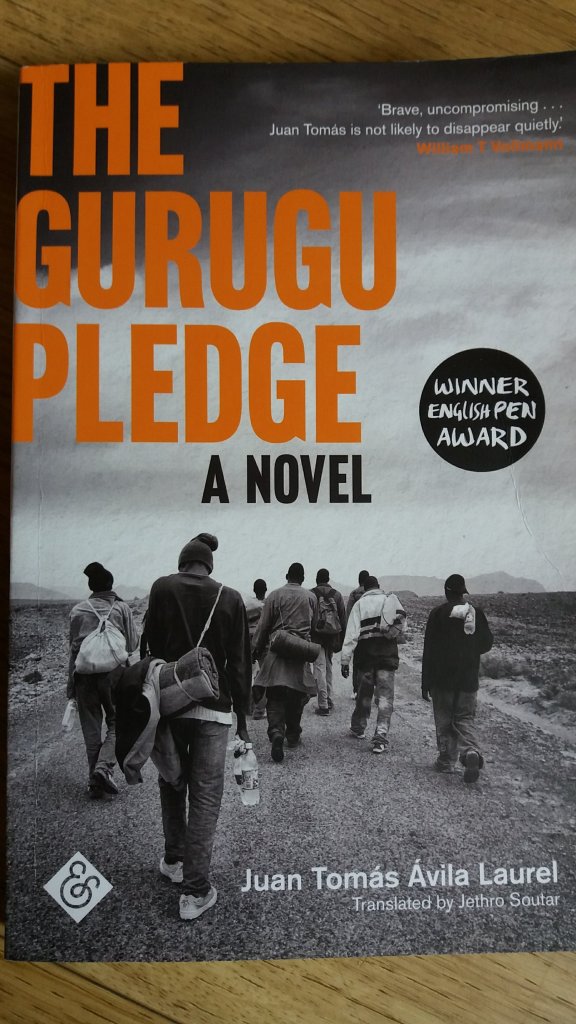
Today’s adult title on my Refugee Week Book Blog is The Gurugu Pledge by Juan Tomás Ávila Laurel, translated from Spanish by Jethro Soutar (And Other Stories).

To give some background to the novel, it is worth mentioning that Spain has two enclaves in Northern Africa: Melilla and Ceuta. As Spanish territories and therefore European territories, they act as a glimmer of hope to refugees desperate to make it to Europe. Climbing the fence to Europe is perhaps less perilous than the alternative boat journeys to the mainland but it is still fraught with danger. Juan Tomás Ávila Laurel is a writer from Equatorial Guinea who now lives in exile in Spain.

This novel joins a group of Africans living on the side of Mount Gurugu in Morocco, not far from the border with Melilla. For the most part, the migrants are left to their own devices as long as they stay up on the mountain, but they are rejected by the local population and treated brutally by the Moroccan police should they stray into the local towns looking for food or medical aid. On the mountain there is precious little to eat and inhabitants are lucky to get a blanket to sleep under in their caves at night

The first part of the book focuses on storytelling, the Africans sharing their stories among each other, telling the reasons for leaving their homelands. Interspersed with these stories, we are also given an idea of what life is like on the mountain. Playing football offers some relief from the daily battles against hunger and idleness: they are not allowed to work, they have nowhere else to go and so football keeps their bodies and minds engaged. They organise a tournament, but on the day of the tournament, an occurrence take place which means the tournament does not go ahead.

We are told the story of Shania. The group she is travelling with reaches a checkpoint run by “bandits dressed in official uniforms but accountable to nobody”. Spotting a woman amongst the group, the supervisor becomes “exercised and upset”. He takes Shania and shuts her in a room. Shania’s husband is at a loss as to what to do and so another man in the group comes forward and negotiates with the supervisor. Shania is released and the group leaves the checkpoint, Shania with tears flooding down her face, a disgusting smell emanating from her body. In her fear, she has soiled herself. She removes her underwear and leaves them at the side of the path. The young man who has negotiated her release promises to buy her a new pair of knickers, but “the promise became a threat”. And so in order to pay her debt, Shania is regularly called upon at night by different men sent to her by the man who “saved” her. While Shania has been saved from one awful fate, she is now living a nightmare.

Due these repeated visits, Shania and another woman are now in need of desperate medical attention. As they cannot walk, the women are carried to look for help, but rather than receive the assistance they desperately require, they are beaten by the police and left for dead. Shania miscarries in a “dry riverbed at the bottom of Mount Gurugu”. Two men escape before the beating and return to camp to tell the story and the following morning Shania and those with her hear “war cries coming from further up the mountain.” What happens next is the migrants response.

Ávila Laurel packs in so many different themes in this relatively slender book. For a look at some of these other themes, please read this fantastic review by Kapka Kasabova on the Guardian website. As Kasabova states, this is “a stark reminder that what is dystopia to some is everyday reality to others”. Two topics that really stood out for me are the abuse and suffering of women and Ávila Laurel’s discussions on the aspirations of black children.

On children he says: “You can’t expect a child, no matter how humble, to say when I grow up I want to be an agency cleaner at Charles de Gaulle airport. Or when I grow up I want to be a fake-handbag salesman, never mind a razor-wire acrobat or a shipwreck rescuee.” We need role models in society of all colours to inspire and encourage all children to achieve their full potential.

 Back to Refugee Week Book Blog

Uncategorized

Refugee Week Book Blog: The Journey by Francesca Sanna

Today’s book choices focus on journeying, starting with a book endorsed by Amnesty International: The Journey by Francesca Sanna (Flying Eye Books).

As the author explains, this isn’t a book about a specific journey and, as such, the reader isn’t told where the family are fleeing from and where they are going to. The book is written in the first person from the child’s perspective. One particularly heart-wrenching page is nearly all black with the words: And one day the war took my father. The mother is left alone with her children and takes the decision to leave the country with her two children.

The inner strength of the mother really comes through. On one page we see the mother holding her awake children to her and the colours around her include splashes of oranges and yellows and greens. On the opposite page we see the same image but the children are asleep and only now does the mother release her tears, the colours now muted blues and darker greens. I love how the tears form part of the the mother’s hair.

As the family progress on their journey, we see all the different ways they travel: in their own car, in the back of a van, in a lorry squashed among vegetables, on a bike, on foot, by boat and finally by train. We feel the despair and the fear along the way, as they hide in bushes trying not to attract attention to themselves. We leave the family on a train, crossing many borders. The book closes saying: I hope, one day, like these birds, we will find a new home. A home where we can be safe and begin our story again. Powerful words from a powerful book.

The illustrations in this book are just stunning and there is such detail, cleverly weaving dangerous looking eyes and fingers into the background.

What my daughter had to say:

Emma (5): I like all the birds at the end. I wouldn’t like to do a journey like that. 

For more World Kid Lit titles, you can also visit the World Kid Lit blog.

Back to Refugee Week Book Blog

Uncategorized

Refugee Book Blog: Dear World. A Syrian Girl’s Story of War and Plea for Peace by Bana Alabed

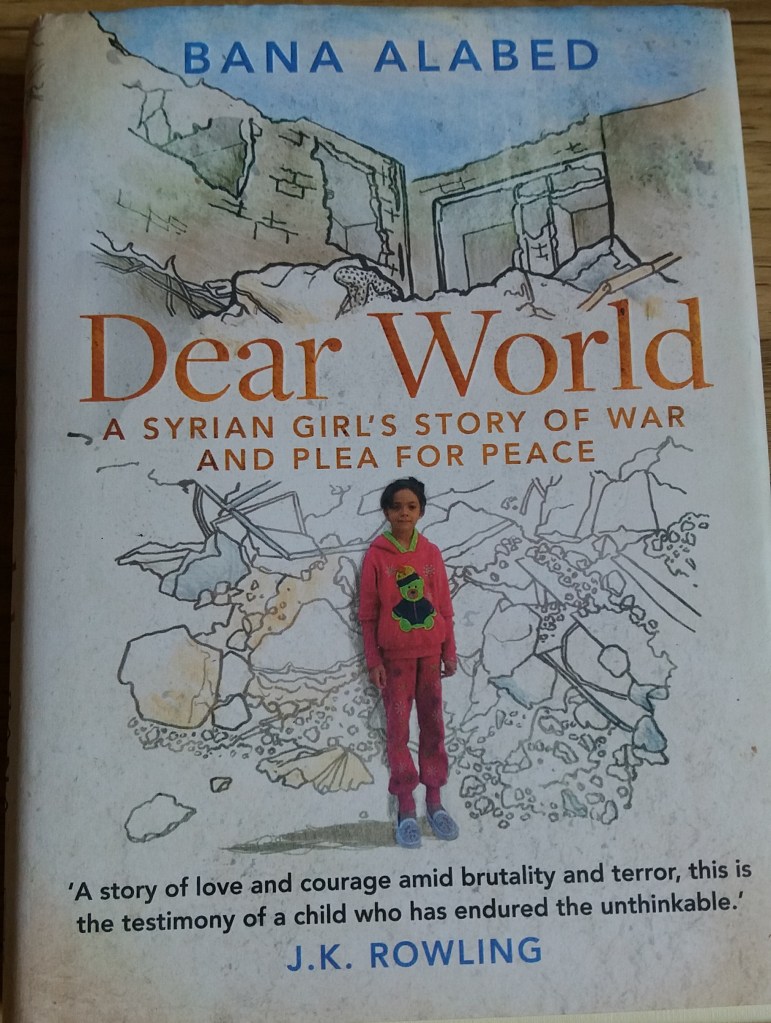
In 2016, eight-year-old Bana Alabed starting using Twitter to tell the world about what was happening to her family under siege in Aleppo, Syria. This book is her story about what happened to her and her family.

Originally I presumed this was a children’s book, but with the intense situations and colour photographs showing the brutal consequences of war, this is not one I would recommend for a young audience. Interspersed with letters to Bana written by Fatemah, her mother, Bana tells of her best friend dying, her home being specifically targeted by bombers and the arrival of her new baby brother against a backdrop of destruction and fear.

As a parent to an eight-year-old myself, I found this account absolutely heartbreaking and in places, difficult to read. In one of her letters, Fatemah says she now laughs about worrying about whether Bana was eating too many sweets: “What I wouldn’t have given for those to have remained my greatest concerns. To worry about what you ate, and not whether you would even have any food to eat”. Arguing about sweets is a regular occurrence in our house and this really put the situation into perspective for me.

With colour photographs accompanying the text, this book is very vivid, offering a child’s perspective on the horrors of living through war: destruction, violence and death. A reminder that war does not just touch the lives of adults, but that children too are caught up in the fighting. For anyone questioning why refugees are leaving, hand them a copy of this book and ask them if they would stay. Had this been written by an adult, it would be a powerful testimony. The fact it is written by a child makes it even more so.

Back to Refugee Week Book Blog